

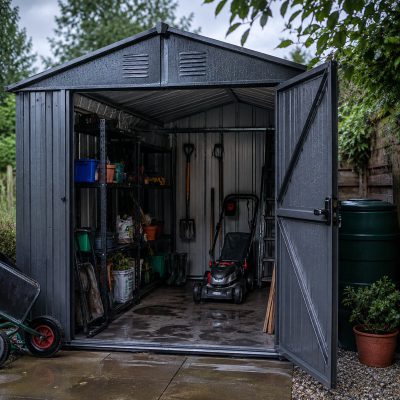
There is something particularly annoying about opening a garden shed expecting to find your tools exactly as you left them, only to discover that everything feels slightly damp.
The lawnmower is covered in tiny droplets. The garden tools have started developing patches of rust. Cardboard boxes feel soft around the edges. Paper, gardening gloves and anything made from untreated wood seem to absorb moisture overnight.
And if you have a metal shed, you may have noticed that the problem can be much worse than you expected.
It is tempting to assume that water must be getting in through a leak. Sometimes it is. But if you regularly find moisture on the inside of the roof or walls even when there has been no rain, you are probably dealing with condensation.
This is a particularly common problem in British gardens. Our cool, damp weather, frequent changes in temperature and relatively humid air create exactly the conditions in which condensation likes to form.
The good news is that you do not necessarily need to replace the shed. In many cases, a few simple first steps can make a surprisingly big difference. Start by checking if your shed has any ventilation, such as vents or small openings, and make sure they are not blocked. Next, raise stored items off the floor to keep them away from dampness coming up from the ground. Finally, try to keep the inside of your shed as organised as possible so air can move around your belongings easily. Later on, you can consider adding insulation, improving the flooring or introducing more storage solutions, but these first actions are a reliable way to make a noticeable start.
Why does condensation form inside a metal shed?
The basic principle is quite simple.
Warm air can hold more moisture than cold air. When that moist air comes into contact with a cold surface, the air cools down. If the surface is cold enough, some of the moisture turns into liquid water.
That is condensation.
A metal shed is particularly vulnerable because metal is a very good conductor of heat. The outside temperature can have a fairly immediate effect on the temperature of the metal panels.
Imagine a typical British evening after a mild, damp day. The air inside your shed contains moisture from the garden, the soil, wet tools, damp grass and simply the surrounding atmosphere.
As the temperature drops, the metal roof and walls can become cold much faster than the air inside.
When that moist air touches the cold metal, tiny droplets begin to form.
You may first notice them on the underside of the roof, particularly early in the morning.
If the conditions are right, there can be enough condensation for those droplets to run down the walls or drip onto whatever you have stored underneath.
British weather makes the problem worse
Metal shed condensation is not unique to the UK, but our climate is almost tailor-made for it.
British gardens often experience damp mornings, cool nights, frequent rainfall and relatively rapid changes between daytime and night-time temperatures.
Even during summer, a shed can become surprisingly humid.
A sunny afternoon may heat the air inside considerably. Once the sun disappears, the thin metal panels can cool rapidly. The warm, moisture-laden air inside then meets the cold metal surface.
Winter creates a slightly different problem.
The shed may remain cold for much of the day, while damp air enters whenever the door is opened. If wet coats, muddy boots, garden equipment or recently used tools are stored inside, they introduce even more moisture.
So condensation is not necessarily a sign that your shed is badly made.
It is often the result of moisture + temperature difference + insufficient ventilation.
Why metal sheds are more prone to condensation than you might expect
Metal has several characteristics that make condensation noticeable.
Metal changes temperature quickly
Unlike a heavily insulated timber structure, a thin metal panel can become cold relatively quickly when the outside temperature falls.
That means the inside surface of the panel can reach the dew point while the air inside is still relatively moist.
Metal does not absorb moisture
This is another important difference.
Wood can absorb and release some moisture. Metal cannot.
When moisture reaches the inside of a metal panel, it remains on the surface as droplets rather than being absorbed into the material.
That makes condensation much more obvious.
The roof can become particularly cold
The underside of the roof is often one of the first places where condensation appears.
At night, the roof can lose heat rapidly, and because warm, humid air naturally rises, it can collect directly underneath the coldest part of the structure.
This is why you may open your shed in the morning and find the roof covered in droplets even though the walls look relatively dry.
Ventilation is usually the first thing to improve
If I had to choose one place to start, it would be ventilation.
A shed does not need to be draughty, but it does need a way for humid air to escape and fresher air to enter.
Without adequate airflow, moisture simply accumulates.
A pair of properly positioned ventilation openings can be much more effective than having one small vent on a single wall. Ideally, you want air to be able to move through the shed rather than simply enter and stop.
This is where ventilation kits for sheds can be useful.
A dedicated ventilation kit can provide controlled airflow without leaving the main door open, which is particularly useful when the shed is used for storing tools, equipment and other items that need to remain dry.
Where should shed vents go?
If possible, create ventilation at different heights.
A lower vent allows cooler air to enter while a higher vent gives warmer, moist air somewhere to escape.
You do not need a powerful fan running constantly in a typical domestic shed. In many cases, passive ventilation is enough to make a noticeable difference.
However, ventilation should not be treated as a cure for every condensation problem.
If the shed is full of wet equipment and there is only a tiny gap for air movement, simply adding one vent may not be enough.
Do not block the vents with stored items
This is an easy mistake to make.
You install a vent, feel that the condensation problem is solved, and then six months later a stack of boxes or a shelving unit is pushed directly in front of it.
Technically, the shed is ventilated.
Practically, the airflow is being blocked.
When arranging the interior, leave enough space around ventilation openings for air to move freely.
This is also one reason why a proper shed shelving system can be useful.
Instead of piling everything against the walls and leaving no room for airflow, shelving allows you to organise your equipment while keeping air moving around it.
Insulation can reduce the temperature difference
Ventilation deals with moisture in the air. Insulation tackles another part of the problem: the cold surface.
Because metal panels respond quickly to outdoor temperatures, insulating the inside of the shed can help keep the internal surface temperature more stable.
The aim is not necessarily to turn your garden shed into a warm room.
Rather, you are trying to reduce the dramatic temperature swings that make condensation more likely.
Insulating the roof can be particularly worthwhile because the underside of the roof is often where condensation is most noticeable.
Depending on the shed design, suitable insulation boards, foil-backed materials, or other purpose-designed shed insulation products can be used.
The important thing is to install insulation properly rather than simply pushing random materials against the metal.
Poorly installed insulation can trap moisture against the panel and create a different problem.
Insulation and ventilation work better together
It is easy to think of insulation and ventilation as competing solutions.
They are not.
Insulation helps reduce how cold the internal surfaces become. Ventilation helps remove moisture from the air.
If you only insulate but allow humid air to build up inside the shed, condensation can still occur.
If you only ventilate but have extremely cold, uninsulated metal panels, condensation may still appear whenever the surface temperature falls below the dew point.
For a shed that suffers from persistent condensation, tackling both sides of the problem is often much more effective.
Your shed floor can make a bigger difference than you think
The roof gets most of the attention, but moisture can also come from below.
A metal shed sitting directly on damp ground can be exposed to moisture rising from the soil or entering through small gaps around the base.
The floor itself can also become a cold surface.
If you store cardboard boxes, paper or wooden items directly on the shed floor, they are much more vulnerable to dampness.
Keep stored items off the ground
Even if you do not have a serious condensation problem, keeping valuable or moisture-sensitive items off the floor is a sensible precaution.
A raised shed floor, suitable flooring system or storage platform can create a small air gap underneath your belongings and reduce their direct exposure to moisture.
This is particularly useful for:
- Cardboard storage boxes
- Paper and documents
- Wooden garden tools
- Fertiliser and gardening supplies
- Spare textiles
- Electrical equipment
- Items that are prone to rust
A plastic storage box placed directly on a cold, damp floor is still exposed to the environment. Raising it on shelving or a platform gives you another layer of protection.
Moisture absorbers can help with smaller sheds
For a small garden shed, moisture absorbers can be a useful addition.
They work by drawing moisture from the surrounding air and collecting it in a container.
They are particularly handy during periods when the shed cannot be ventilated as effectively, or for cupboards, storage boxes and enclosed areas where air circulation is poor.
However, I would not rely on moisture absorbers as the main solution for a heavily affected shed.
If you are emptying the container constantly because it is filling with water, that is telling you something.
There is probably too much moisture entering the shed or not enough moisture leaving it.
Think of a moisture absorber as an extra layer of protection, not a substitute for proper ventilation.
Be careful about storing wet equipment
This is one of the easiest ways to create condensation without realising it.
You come back from the garden with a wet spade, muddy boots, damp gloves or a hose that has not completely drained.
The shed seems like the obvious place to put everything.
But now you have introduced a significant amount of water into a relatively enclosed space.
That moisture has nowhere to go.
It evaporates into the air and eventually finds the coldest surfaces.
If possible, allow wet equipment to dry before putting it away.
You do not need to become obsessive about it. Garden tools are going to get wet. That is their job.
But if you regularly put dripping equipment into a closed metal shed and then wonder why the roof is wet the next morning, the connection is fairly straightforward.
Avoid packing the shed too tightly
A full shed might look like good use of space, but it can be terrible for airflow.
Boxes pushed tightly against the walls create little pockets where moist air becomes trapped.
Large items placed directly underneath the roof can also restrict air movement around the area where condensation is most likely to form.
This is another area where shelving systems can help.
Instead of storing everything in one large pile, use shelves to create vertical storage and leave some space between the stored items and the shed walls.
You do not need a huge gap.
Even modest air circulation is preferable to having everything pressed tightly against the metal panels.
One common mistake: keeping the shed permanently sealed
It might seem logical that the best way to keep a shed dry is to keep the door shut.
Unfortunately, a completely sealed shed can become a moisture trap.
Every time you open the door, humid outdoor air enters. Moisture also comes from whatever you store inside.
If there is no route for that moisture to escape, it remains inside until conditions change.
That is why ventilation matters even if the shed is otherwise watertight.
A shed can be completely rainproof and still have a serious condensation problem.
Another mistake: assuming every wet surface means a leak
This is worth checking before you start sealing every joint.
Look at where the water is appearing.
If you find droplets evenly distributed across the underside of the roof or a mist-like layer of moisture on the metal panels, condensation is a strong possibility.
If you find a concentrated wet patch near one seam, fixing, corner or damaged panel, investigate for a leak.
Sometimes you can have both.
A small roof leak and poor ventilation are perfectly capable of working together to make the shed considerably wetter than either problem would cause on its own.
Don’t forget about the shed’s surroundings
The area immediately around your shed can also influence moisture levels.
If the shed sits in a permanently shaded, damp corner of the garden with poor air circulation, the surrounding environment is going to stay humid for longer.
Overhanging vegetation can restrict airflow and keep the area around the shed damp after rain.
Where possible, allow some space around the shed and keep vegetation from completely enclosing it.
Good drainage around the base is also worth checking.
If rainwater consistently collects around the shed rather than draining away, solve that problem first.
A simple way to reduce condensation without changing everything
You do not necessarily need to tackle the entire shed in one weekend.
If condensation is becoming a nuisance, I would start with a few practical changes.
First, check whether the shed has adequate ventilation and whether the existing vents are actually unobstructed.
Then look at the floor. If boxes and equipment are sitting directly on the ground, raise them.
Next, reorganise the interior so that items are not packed tightly against the walls or underneath the roof.
If condensation remains a problem, consider adding insulation, particularly around the roof.
For a small enclosed shed, moisture absorbers can provide an additional layer of protection.
And if you regularly store wet equipment inside, give it a chance to dry first whenever practical.
These changes may sound fairly basic, but together they address the main sources of the problem rather than simply trying to mop up the water afterwards.
A better storage setup can protect your belongings too
Reducing condensation is only half the job.
You also want to make sure that the things inside the shed are not unnecessarily exposed to moisture.
This is where storage becomes important.
A good shelving system can keep items away from the floor, improve airflow and make it easier to leave a little space around the walls.
For moisture-sensitive items, sealed plastic containers are generally a safer choice than cardboard boxes.
Paper documents should ideally be kept somewhere indoors if they are important or irreplaceable. A garden shed, even a well-maintained one, is still a relatively uncontrolled environment.
Tools and garden equipment are more forgiving, but they should still have enough ventilation around them to dry properly.
When condensation keeps coming back
If you have improved ventilation, raised your stored items, reduced moisture sources and checked for leaks but the shed still becomes soaked with condensation, it is worth looking at the structure itself.
Ask yourself a few questions.
- Is the shed particularly thin or poorly insulated?
- Is the roof much colder than the rest of the structure?
- Is there enough airflow between the walls and the stored items?
- Does the shed sit directly on damp ground?
- Does the condensation appear mainly overnight?
- Does it become worse after storing wet tools or opening the shed on rainy days?
The answers can help identify whether you need more ventilation, better insulation, improved flooring or simply better moisture management.
There is rarely one magic product that solves every condensation problem.
The most effective approach is usually to control the moisture source, improve airflow and reduce the temperature difference between the inside air and the metal surface.
And once you understand why the water is appearing in the first place, that frustratingly wet shed becomes a much easier problem to manage.