

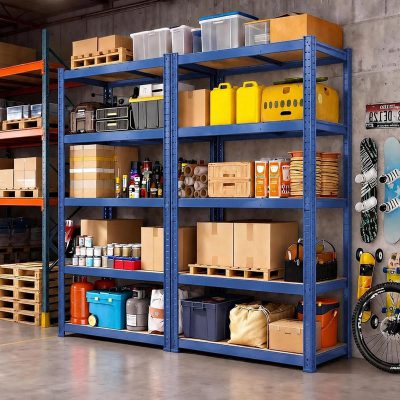
There is a particular stage in every garage tidy-up that feels strangely satisfying.
You clear the floor, put a few boxes on the shelves, line up the paint tins, and find a sensible place for the garden tools. For a day or two, the garage looks almost respectable.
Then life carries on.
A few months later, another box is beside the shelves. Christmas decorations have been added to the top level. A half-used tin of paint has somehow joined three other half-used tins. There are cables nobody remembers owning, camping equipment that only gets used twice a year and a toolbox that is never quite put back where it belongs.
The shelves are still there. Technically, everything is stored.
But somehow the garage looks worse.
This is one of the problems with open shelving. It can give you a huge amount of storage space without actually making the space feel organised. If you are not careful, a perfectly good shelving unit can slowly turn into a rather impressive display of things you cannot be bothered to sort out.
The good news is that the problem usually isn’t a lack of shelves. It is how the available space is being used. If you want a quick win, start by removing everything from your shelves and grouping similar items together on the floor. This one action makes it much easier to see what you actually have and gives you a clear place to begin.
The Garage Becomes the Home for Everything Nobody Has a Place For
Most garages don’t start as storage rooms.
They gradually become one.
The old garden chair goes in there because it might be useful one day. Then come the Christmas decorations, spare light bulbs, decorating equipment, children’s bikes, leftover flooring, DIY tools and that box of cables you are certain will be useful eventually.
There is nothing particularly unusual about this. A garage is one of the few spaces in a typical UK home where you can shut the door and stop thinking about the problem.
Until you need something.
That’s when the trouble starts.
You remember putting the camping stove somewhere near the back. Twenty minutes later, you have moved three boxes, opened one bag full of things you don’t recognise and discovered a Christmas wreath from 2018.
This is where shelving can make a genuine difference, but only if it helps you see and reach what you actually have.
Simply getting everything off the floor isn’t enough.
Open Shelves Can Become a Rubbish Display
Open shelving is useful because you can see everything.
It is also its biggest weakness.
When a shelf is empty, it looks wonderfully practical. Once it is full, however, the reality can be rather different. Items get pushed towards the back, smaller things disappear behind larger ones, and anything that doesn’t have an obvious home gets placed wherever there happens to be a gap.
Eventually, the shelving becomes a collection of random objects rather than a storage system.
You might have paint tins on one shelf, a cordless drill sitting beside a bag of cable ties, two boxes of Christmas decorations underneath and a football wedged between them.
Nothing is necessarily wrong with any individual item. The problem is that there is no logic to where anything lives.
A useful garage shelf should answer a simple question:
Can I find what I need without moving five other things first?
If the answer is no, the shelving isn’t doing quite enough.
Put the Things You Use Most at Eye Level
One of the easiest ways to make garage shelving more practical is to stop treating every shelf as equal.
The shelves around eye and waist height are your prime storage space. They should be reserved for things you use regularly or things you need to find quickly.
Think about:
- Everyday DIY tools
- Frequently used cleaning products
- Car care supplies
- Small tool boxes
- Extension leads
- Garden equipment you use throughout the season
- Screws, fixings and other small essentials
If you regularly need something, don’t make yourself bend down or reach over a pile of boxes to get it.
There is also a psychological benefit. When frequently used items have a clearly visible place, you are much more likely to put them back there.
That sounds obvious, but it makes a surprisingly big difference.
A shelf is not just about where something can fit. It should also make the right behaviour easy.
The Bottom Shelf Is for the Heavy and Awkward Stuff
The bottom level is usually better suited to heavier items.
Paint tins, power tools, bulk storage boxes, bags of soil and other weighty equipment are much easier to handle when they are close to the floor.
There is another reason to keep heavy things low: stability.
You don’t really want a large, heavy box sitting above head height. Apart from making it awkward to retrieve, it can make the whole shelving unit more top-heavy.
The bottom shelf is also a good place for things you don’t use particularly often but still need to access from time to time.
Seasonal equipment is a good example. Christmas decorations don’t need to occupy prime shelf space in July. Camping gear might only come out a handful of times a year.
Put those things lower down or higher up, depending on their size and weight, and keep your everyday items where you can reach them easily.
What About the Very Top Shelf?
The top shelf can be useful for lightweight seasonal items.
Artificial Christmas decorations, empty bags, lightweight camping equipment and similar items can work well here.
But there is a temptation to use the top shelf as a dumping ground.
That’s how you end up with a mountain of boxes that you can’t see into and don’t really want to climb up to retrieve.
If you need a step ladder every time you want something, it probably shouldn’t be something you use regularly.
Don’t Put Everything Into Storage Boxes
Storage boxes are brilliant.
They are also capable of hiding a problem rather than solving it.
There is something very satisfying about putting a collection of miscellaneous things into a neat plastic box, adding a label and sliding it onto a shelf.
The trouble starts when you have twenty boxes.
You know there are Christmas lights in one of them. You know there are old cables somewhere. You are fairly sure the spare drill bits are in another one.
But which one?
Soon, instead of looking for the item you need, you are looking for the box containing the item you need.
This is why I wouldn’t recommend putting everything in containers simply because containers make a garage look tidier.
Use boxes where they genuinely help.
Small loose items are an obvious example. Screws, cable ties, plugs, decorating accessories and similar bits and pieces are much easier to manage when they are contained.
Seasonal items can also benefit from being boxed together. There is little point in having twenty individual Christmas decorations scattered across four shelves.
But large, frequently used or easily identifiable items don’t necessarily need a box.
A toolbox can sit on a shelf.
A pressure washer hose can have its own place.
A tin of paint can be seen and reached without being packed into another container.
Sometimes the simplest storage system is the one you will actually maintain.
The Deep Shelf Trap
This is one of the most common shelving mistakes.
When people are buying a shelving unit, deeper shelves often sound better.
More depth means more space, right?
Not necessarily.
A deeper shelf can certainly hold more, but that doesn’t automatically mean it provides more useful storage.
Imagine a shelf that is 60cm deep.
You put a large storage box at the front. Behind it is another box. Then another item gets pushed into the remaining space.
Technically, you’ve used all 60cm.
Practically, you’ve created a small archaeological excavation.
The thing at the back may as well not exist.
This gets particularly annoying with smaller objects. You can see the front row clearly, but everything behind it becomes part of the background. When you eventually need something from the back, you have to remove half the shelf first.
Why Deeper Doesn’t Always Mean Better
The ideal shelf depth depends on what you are actually storing.
If you’re storing large tool cases, bulky garden equipment or sizeable boxes, extra depth can be useful.
But for smaller household items, excessive depth often creates wasted space.
You end up with:
A front zone that is easy to reach.
A middle zone that you occasionally use.
A back zone that effectively disappears.
That isn’t really three storage areas. It’s one useful storage area with a pile of things behind it.
For many garages, a slightly shallower shelf that allows you to see everything can be far more practical than a very deep unit packed from front to back.
Think About Visibility Before Capacity
When organising a garage, it is tempting to measure success by how much you can fit onto the shelves.
I think there is a better question:
How much of it can you actually see?
If you have 30 storage boxes but can’t remember what’s in half of them, your garage may technically have plenty of storage capacity while still being difficult to use.
A good storage system reduces the amount of thinking required.
You should be able to walk into the garage and quickly spot the paint tins, find the drill, grab the camping stove and put everything back without starting another round of tidying.
That is why grouping similar things together is often more useful than simply maximising shelf space.
Keep decorating supplies together. Keep car care products together. Give camping equipment its own area. Put Christmas decorations in one clearly defined section.
You don’t necessarily need a label on every shelf.
You just need a system that makes sense.
Give Random Things a Home
There will always be awkward objects in a garage.
A length of leftover cable.
A single spare tile.
An old extension lead.
A bicycle pump.
A bag of miscellaneous screws.
The mistake is allowing these things to spread across the entire shelving unit.
It can help to have one designated area for the genuinely random stuff.
Not half a shelf on every level. One area.
That way, when you find something that doesn’t have an obvious home, you know where it goes.
But there is a useful rule here: if the same “random” item keeps appearing, it may deserve its own category.
If you have cables everywhere, you probably have enough cables to justify a cable box.
If you keep finding garden gloves in three different places, give them a dedicated spot.
A good storage system should evolve with the things you actually own.
Leave Some Empty Space
This is probably the hardest part.
When you’ve finally bought shelving and started organising the garage, there is a strong temptation to fill every available centimetre.
Don’t.
Leaving a little space is useful.
It gives you somewhere to put something temporarily without immediately destroying the whole system. It also allows for the inevitable addition of another tin of paint, a new tool or the Christmas decorations when December comes around.
If every shelf is already packed tightly, one new item can cause a chain reaction.
Suddenly the box moves to another shelf, something else gets pushed to the floor, and within a few weeks you’re back where you started.
A garage needs a little breathing room.
Shelving Should Make Life Easier, Not Just Make the Garage Look Tidier
There is a difference between organised storage and stuff that happens to be stacked neatly.
The first one saves you time.
The second one usually lasts until you need something.
The best shelving arrangement isn’t necessarily the one that fits the greatest number of boxes. It is the one that matches the way your household actually uses the garage.
Keep frequently used items within easy reach. Put heavy things low. Keep seasonal belongings out of prime positions. Don’t hide everything inside identical boxes. Avoid using unnecessary depth simply because the shelf offers it.
And perhaps most importantly, don’t be afraid to leave some things visible.
A garage isn’t a showroom. It is a working part of the house.
If you can walk in, find what you need and put it away again without swearing at a pile of boxes, the shelves are doing their job.
For households looking to make better use of garage, utility or general storage space, Home Pet Essentials also offers practical shelving and storage solutions designed for everyday use, including options that can help keep heavier household items, tools and boxes off the floor and make them easier to organise.