

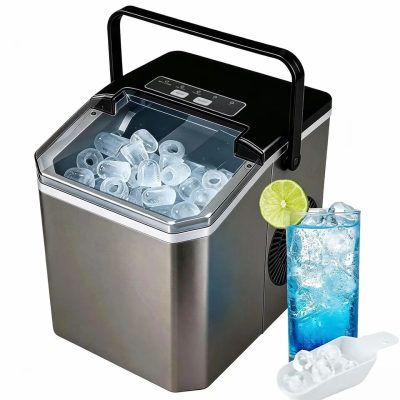
It is a familiar sort of kitchen moment. You fill the ice maker before a barbecue, switch it on and get on with making lunch. A little while later, you hear the familiar sound of ice dropping into the basket.
Except the ice looks a bit odd.
The pieces are much smaller than usual, or they have a large hollow centre. They still look like ice, but they do not have the solid, satisfying weight you would expect. Put a few into a glass and they disappear into the drink surprisingly quickly.
This can be particularly noticeable with portable ice makers, which are popular in UK kitchens, home bars, garden rooms and during the warmer months when the freezer seems to be permanently short of ice.
Before assuming the machine has broken, it is worth understanding how this type of ice maker actually produces ice. A small change in water flow, temperature, freezing time or general maintenance can affect the shape and size of the finished ice.
How Does an Ice Maker Actually Make Ice?
Most compact ice makers do not freeze a tray of water in the same way as a conventional freezer.
Inside the machine is a refrigerated evaporator, often made up of several cold metal rods or fingers. A small pump takes water from the reservoir and circulates it over these cold surfaces. As the water comes into contact with the chilled evaporator, it begins to freeze layer by layer.
This is also why some portable ice makers naturally produce hollow or bullet-shaped pieces.
The outside of the ice freezes around the cold evaporator surface while some of the remaining water continues to flow back into the reservoir. Once the ice reaches the required size, the machine stops the freezing stage and uses a short warming or release cycle to loosen the ice from the evaporator.
So, a hollow centre on its own is not necessarily a problem.
The important question is whether the ice has become noticeably smaller, thinner or more hollow than it normally is.
That is when it is worth looking at what may have changed.
Why Is My Ice Maker Producing Small or Hollow Ice?
Several things can influence the amount of ice that forms during each freezing cycle. In many cases, the cause is surprisingly simple.
The Water Is Too Warm
The temperature of the water going into the machine has a direct effect on how quickly ice can form.
If you fill the reservoir with warm or room-temperature water, the machine has to remove more heat before freezing can happen efficiently. The first few cycles may therefore take longer, and the resulting ice can be smaller.
This becomes more noticeable during a warm spell. Using reasonably cool drinking water can help the machine reach its freezing stage more efficiently, although there is usually no need to use extremely cold or iced water.
The Room Is Too Warm or Ventilation Is Restricted
Portable ice makers have to remove heat from the water and release that heat into the surrounding air. If the machine is sitting beside a cooker, radiator or sunny window, it has to work in a warmer environment. Restricted airflow around the ventilation openings can make the problem worse.
This is easy to overlook in summer. A kitchen, conservatory or garden room can become considerably warmer than it feels first thing in the morning.
Keep the machine away from obvious heat sources and give the ventilation areas enough space. Do not push it tightly against a wall or cover any vents.
There Isn’t Enough Water Flow
An ice maker needs a reasonably consistent supply of water across its evaporator.
If the pump is struggling, the water level is too low, or part of the water path has become restricted, the evaporator may not receive enough water during the freezing cycle.
The result can be thin layers of ice rather than properly developed pieces.
This is one reason why simply topping up the reservoir and restarting the machine does not always solve the problem. If water is not circulating properly, there may be an underlying maintenance issue.
Mineral Build-Up Can Interfere With the Process
This is an easy one to overlook.
Tap water contains minerals. The exact amount varies considerably depending on where you live, and hard water areas can produce mineral deposits more quickly.
Over time, scale can build up around parts of the water system, including the evaporator and areas involved in water circulation. Even a relatively small amount of build-up can affect how water moves across the cold surfaces.
If your ice maker used to produce larger, well-formed pieces but has gradually started producing smaller or thinner ice, scale is worth considering.
Regular cleaning is much easier than waiting until the machine starts behaving strangely.
The Freezing Cycle Is Being Interrupted
Ice needs time to build up.
If a machine is repeatedly switched off, moved around, restarted or interfered with during operation, its normal cycle can be interrupted.
The same applies if you are constantly changing settings or trying to force the machine to produce ice faster.
An ice maker is not really designed to work like a machine that you can rush. The refrigeration system needs time to remove heat from the water, and the ice needs enough time to develop to the intended size.
If the machine normally produces good ice when left alone but smaller pieces when it is frequently interrupted, the solution may simply be to let it complete its cycle.
The Machine May Need More Time Than Usual
Not every change in ice size means something has gone wrong.
The first batch can sometimes be smaller than later batches because the machine is starting from a warmer condition. A warm kitchen, recently added water or repeated use can also affect how quickly the next batch forms.
Rather than judging the machine from one batch, look for a consistent pattern.
If the ice returns to its normal size after the machine has been running for a while, there may be no underlying fault. If every cycle remains noticeably smaller than before, it is worth investigating further.
Small Ice and Hollow Ice Are Not Quite the Same Problem
It is useful to separate these two symptoms.
A naturally hollow bullet-shaped piece of ice can be perfectly normal for this type of machine. The hollow centre is part of how the ice forms around the evaporator.
Very thin walls, unusually large hollow centres or pieces that are dramatically smaller than usual are different.
For example, if you normally get reasonably substantial pieces but suddenly start getting tiny shells of ice, something has probably changed. Water temperature, water circulation, scale, ventilation and the freezing cycle are all worth checking before assuming the machine itself has failed.
The change in performance is often more useful information than the shape of one individual piece of ice.
A Few Everyday Habits Can Make a Surprisingly Big Difference
Ice makers are fairly straightforward appliances, but they do benefit from a little routine care.
Keep the Water Reservoir Clean
Do not treat the reservoir as a permanent water tank.
Old water can pick up dust, odours and residue, particularly if the machine is left unused for several days. Emptying the reservoir and giving it a proper clean is a simple habit that also makes the machine more pleasant to use.
If you know you will not be using it for a while, emptying and drying it is preferable to leaving water sitting inside.
Clean Away Scale Before It Becomes Obvious
You do not need to wait until you can see a thick white layer of limescale.
Following the manufacturer’s cleaning instructions at regular intervals can help keep the water path and evaporator in better condition. The exact cleaning method matters, so it is better to follow the instructions supplied with your particular machine rather than assuming every ice maker should be cleaned in exactly the same way.
In a hard-water area, you may need to pay more attention to this than someone using softer water.
Start With Fresh, Reasonably Cool Water
When the machine is being used throughout the day, replacing old water with fresh water is a sensible habit. Reasonably cool water can also reduce the amount of heat the machine has to remove before freezing begins.
There is no need to use iced water, though. The machine still needs to complete its refrigeration cycle.
Give It Enough Space
Good ventilation is easy to overlook, especially when a compact ice maker is sitting on a crowded kitchen worktop.
Keep the unit away from heat sources and make sure the ventilation openings are not blocked. This helps the refrigeration system release heat properly and can make a noticeable difference when the room itself is warm.
Let the Machine Do Its Job
If you need a large quantity of ice, it is tempting to keep checking whether the next batch is ready or repeatedly restart the machine.
That usually does not help.
Once the machine has started a freezing cycle, give it time to complete it. If it has different ice-size settings, choose the one you actually need rather than trying to compensate for small ice by repeatedly changing the cycle.
What If the Ice Is Still Small After Cleaning?
If you have cleaned the machine, checked the water level, improved ventilation and allowed it to run under normal conditions, but the ice remains unusually small, it may be time to look beyond everyday usage.
Pay attention to whether water is circulating properly and whether the refrigeration system appears to be working normally.
A useful clue is the change over time.
If the machine has always produced relatively small or hollow pieces, that may simply be its design or the selected ice size. If it previously produced noticeably larger pieces and has gradually deteriorated, a maintenance or component issue becomes more plausible.
There is also a difference between a machine taking slightly longer to make ice on a warm day and one that consistently struggles even under reasonable indoor conditions.
That distinction can save you from chasing the wrong problem.
A Simple Way to Troubleshoot Small or Hollow Ice
When an ice maker suddenly starts producing poor-quality ice, there is no need to dismantle it straight away.
Start with the basics.
Check the water level and use fresh, reasonably cool water. Make sure the machine has enough space around its vents and is not sitting next to a heat source. Look for visible scale or residue and follow the manufacturer’s cleaning instructions if it has been a while since the last clean.
Then allow the machine to complete several normal cycles without repeatedly stopping or restarting it.
If the ice returns to its usual size, the cause was probably related to operating conditions or maintenance. If it remains consistently small or unusually hollow despite normal conditions, the machine itself may need further inspection.
That simple process is often more useful than changing several things at once, because you can see which change actually makes a difference.
An ice maker is essentially doing one job: removing heat from water and then releasing that heat into the room. Give it clean water, reasonable airflow, enough time and regular care, and there is usually no need to make the problem more complicated than it is.