

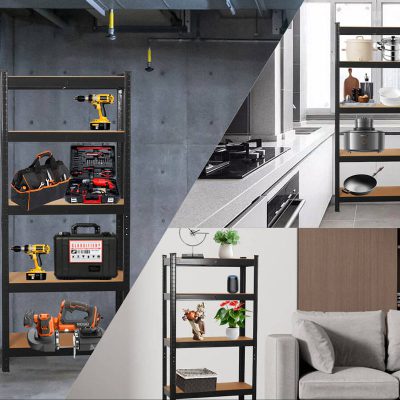
Moving house is one of those jobs that looks straightforward from the outside.
You pack everything into boxes, load the van, carry what feels like half your life through the front door, and eventually reach the point where you can put the kettle on and tell yourself that the difficult bit is over.
It isn’t quite over.
Once the boxes are inside the new house, another job begins: deciding where everything is actually going to live.
This is where people often get a little too confident.
When you’re standing in an empty room, it is easy to look at a wall or an unused corner and think, “We’ll put some shelves there.” The space looks generous. The furniture hasn’t arrived yet. No piles of laundry, cleaning products, books, cables, or awkward household items get in the way.
So the shelves go up.
Then you start living in the house.
A few months later, the same shelving that looked like a sensible storage solution has become slightly irritating. Things disappear at the back. The vacuum cleaner has nowhere to go. Boxes don’t quite fit. A cupboard door catches on the shelf. One corner stays completely unused while another room overflows.
None of these problems is particularly dramatic on its own. Together, though, they can make a home feel much more cluttered and inconvenient than it needs to be.
The mistake isn’t necessarily buying the wrong shelves. Quite often, it is planning storage around space rather than around everyday life. For example, instead of focusing only on empty walls, consider where you tend to drop your keys or shoes each day, or where bags naturally end up when you walk in. Planning storage around these habits can make your home feel much more organised.
The empty-house illusion
One of the easiest mistakes to make after moving house is planning storage before you understand how you are going to use the rooms.
An empty room gives you a completely different impression of space from a lived-in room.
A 2-metre wall might look perfect for a large shelving unit. Once the sofa is in place, the television is mounted, the door opens fully, and you need somewhere to put a lamp, that apparently generous wall can suddenly become surprisingly awkward.
The same thing happens in hallways and utility areas.
You may see a narrow strip of unused wall and think it would be ideal for storage. Then you realise that this is exactly where you normally stand when putting your shoes on, where the hoover needs to pass through, or where the front door swings open.
Good home organisation starts with a slightly less exciting question:
What actually happens in this room every day?
Watch how you move around it before deciding where the shelves should go.
That small bit of planning can prevent a surprising amount of frustration later.
The shelf is too deep, so the useful things disappear
Imagine you’ve just moved into your new home and finally get around to organising the spare room.
There is a large shelving unit against one wall, so you start filling it with storage boxes. It looks fantastic for about five minutes.
The problem becomes obvious a few weeks later.
The box you need is at the back.
You move three other boxes to get to it, discover that the thing you wanted wasn’t actually in that box, and put everything back. Eventually, you stop using the back half of the shelf altogether because it is simply too much effort.
Deep shelving isn’t automatically better shelving.
For frequently used items, excessive depth can turn available storage into inaccessible storage. This is particularly noticeable with shelves holding small household items, books, cleaning products or everyday supplies.
A practical rule for shelf depth
Think about what the shelf is supposed to hold before choosing its depth.
Books need relatively little depth. Small storage boxes need enough room to sit securely without leaving a huge amount of wasted space behind them. Larger household equipment may need more.
If you already have deep shelves, there is no need to replace everything immediately. Pull-out baskets, labelled containers and shallow storage boxes can make the rear of the shelf much easier to access.
The important distinction is between storage capacity and usable storage capacity.
A shelf that technically holds twice as much isn’t necessarily twice as useful if you can never comfortably reach the second half.
You can reach the shelf, but not the back
This sounds similar, but it creates a slightly different problem.
A shelf can have a perfectly sensible depth and still be difficult to use if it is positioned too high, too low or too far into a cramped area.
I’ve seen this happen with storage installed above desks, worktops and appliances. The shelves are technically within reach, but accessing anything at the back involves stretching, standing on something or moving another object first.
That is usually a sign that the storage has been designed around the wall rather than the person using it.
Frequently used items should sit within easy reach.
Things that you only need occasionally can occupy higher shelves or less accessible areas. Seasonal decorations, spare bedding and occasional-use equipment don’t need prime real estate.
There is no reason to waste the easiest-to-reach storage on something you use twice a year.
The shelf height seemed fine until you started putting things on it
Another common post-move discovery is that the shelves are at completely the wrong height.
Perhaps you’ve installed several evenly spaced shelves because they looked neat. Then you try to store a tall bottle, a small appliance or a stack of storage boxes and discover that none of the spaces quite work.
The result is usually one of two things.
Objects get squeezed into spaces that are too small, while other shelves have several inches of empty air above everything.
Adjustable shelving is particularly useful here because the way you store things tends to change over time.
If fixed shelves are already installed, measure the objects you actually own rather than guessing what should fit. Leave enough clearance to take things in and out without having to tilt or force them.
A little wasted vertical space is fine. Constantly fighting with your storage isn’t.
The vacuum cleaner has become a permanent hallway resident
This is one of those problems that usually appears after the rest of the house has been organised.
The books are on the shelves. The boxes are stacked neatly. The kitchen cupboards are sorted.
And the vacuum cleaner is standing in the hallway.
Nobody planned it that way.
There simply wasn’t an obvious place for it.
The same can happen with a mop, ironing board, broom, steam cleaner or folding step ladder. These aren’t particularly attractive objects, so they tend to get pushed into whichever corner is available.
Unfortunately, “wherever it fits” is rarely a good long-term storage strategy.
Before finalising your shelving plan, make a list of the awkward household items that need a home.
Think about the things that are too tall, too wide, too oddly shaped or too frequently used to disappear into a normal cupboard.
A narrow utility shelf, tall storage unit or dedicated vertical section can sometimes solve the problem without taking up much floor space.
The trick is to plan for these objects before they become clutter.
The boxes don’t fit, despite the shelf being the right size
This is another classic moving-house problem.
You’ve measured the shelving unit.
You’ve measured the wall.
Everything appears to fit.
Then you buy some storage boxes and discover that they are either slightly too wide, too tall or too deep.
Suddenly the carefully planned storage system is based on containers that don’t actually work with the shelves.
This is why it helps to choose the storage containers and shelving as one system rather than treating them as completely separate purchases.
If you know you want standard plastic boxes, fabric cubes or archive boxes, measure those first.
Allow some clearance as well. A box that fits exactly may be technically usable, but it can become surprisingly awkward if you need to pull it out regularly.
The same principle applies to baskets.
A basket shouldn’t merely fit inside the shelf. You should be able to remove it comfortably when it is full.
When shelving starts blocking doors
This is the kind of mistake that tends to reveal itself at the worst possible moment.
The shelving looks fine when the door is closed.
Then someone opens the door.
Suddenly the handle hits the shelf, the door only opens halfway, or there is barely enough room to walk through.
It sounds obvious, but moving house involves so many measurements that small clearance issues are surprisingly easy to miss.
Doors, windows, radiators, light switches and sockets all need to be considered when planning storage.
Don’t just measure the wall.
Measure the movement around the wall.
Open the door fully. Pull drawers out. Check where cupboard doors swing. Stand in the space and imagine carrying a laundry basket or a vacuum cleaner through it.
Storage should make movement easier, not turn normal household tasks into an obstacle course.
The forgotten corners that could have been useful
Then there is the opposite problem.
One room is packed with storage while a strange corner elsewhere remains empty.
It might be the space beside a wardrobe, an awkward section underneath the stairs, a narrow gap in the utility room or an unused corner of a home office.
These areas are often ignored because they don’t look like conventional storage space.
But awkward spaces can be some of the most useful ones if the shelving is chosen carefully.
A narrow shelving unit may work where a large cupboard would be too bulky. Several smaller shelves can sometimes make better use of an irregular wall than one large piece of furniture.
That doesn’t mean every empty corner needs to be filled.
Space has value too.
The goal isn’t to cover every wall with shelving. It is to create enough practical storage that the things you use regularly have somewhere sensible to live.
A better way to plan storage after moving house
Rather than buying shelves as soon as you see an empty wall, give yourself a little time to understand the house.
For the first couple of weeks, notice where things naturally end up.
If keys always land on the same table, that tells you something. If shoes accumulate beside the front door, there is probably a storage problem there. And if cleaning products keep appearing beside the kitchen sink, perhaps the existing cupboard isn’t convenient enough.
These everyday habits are useful information.
Start with the objects, not the furniture
Make a rough list of what needs storing in each room.
Don’t just count books and boxes. Include the awkward things that are easily forgotten:
- Vacuum cleaners
- Mops and brushes
- Cleaning supplies
- Shoes
- Bags
- Small appliances
- Tools
- Cables and chargers
- Pet supplies
- Seasonal items
- Spare bedding
- Storage boxes
Then think about how often each item is used.
Everyday items should be easy to reach. Weekly-use items can be slightly less accessible. Seasonal and occasional items can go higher up or further back.
This simple hierarchy makes shelving much more practical.
Measure before you buy
Wall width is only one measurement.
Check the height, depth, door clearance and surrounding furniture as well.
For shelving units, measure the actual internal shelf dimensions rather than relying only on the overall product dimensions. A unit may be 80 cm wide externally but offer considerably less usable space once the frame and supports are taken into account.
If storage boxes are going on the shelves, measure those too.
It sounds tedious when you’re surrounded by moving boxes, but five minutes with a tape measure can save you from buying something that becomes a daily annoyance.
Leave some room for the future
A storage system that is 100 per cent full on the day you install it isn’t necessarily well planned.
Homes change.
You buy new things. Children grow. Hobbies change. Appliances are replaced. Seasonal decorations somehow multiply despite your best intentions.
Leaving a little spare capacity means the system can absorb those changes.
It also makes it easier to put things away properly. When every shelf is packed tightly, even a small amount of new clutter can quickly spill onto worktops, floors and chairs.
Keep frequently used items at the easiest height
A useful storage system should reduce effort.
Items you reach for every day deserve the most convenient positions. Less frequently used things can move upwards or towards the back.
Heavy items are another consideration. Putting heavy boxes high above your head may technically save floor space, but it isn’t particularly practical or safe.
Think about how an object is going to be retrieved, not simply where it can be stored.
Good shelving should make the house feel easier to live in
The best storage isn’t necessarily the shelving that holds the most stuff.
It is the shelving that makes everyday routines easier.
You can reach what you need without emptying half a shelf. The vacuum cleaner has a proper home instead of leaning against the wall. Storage boxes slide in without being forced. Doors open properly. Awkward corners become useful without making the room feel cramped.
That is a much better measure of successful home organisation than simply counting how many shelves you have.
Moving house already involves enough decisions. There is no need to make storage another source of frustration six months later.
Take a little time to see how you actually use the new space. Measure the awkward bits. Think about the things that need storing rather than simply the walls available for shelving. Most importantly, remember that storage exists to support your daily routines.
Once the house starts to feel like home, those small decisions make a surprisingly big difference.
For anyone still sorting out storage after a move, Home Pet Essentials has a range of shelving and home storage options that can help make better use of walls, corners and otherwise awkward spaces. The right unit won’t solve every organisation problem, but choosing one that fits the way you actually live is a very good place to start.