

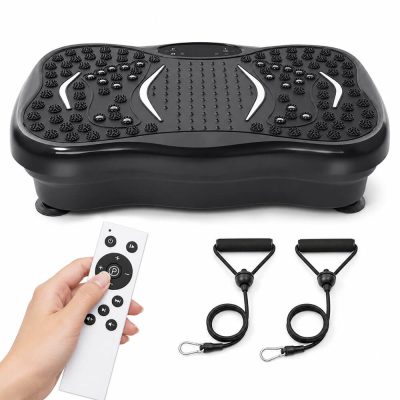
A few years ago, a vibration plate was the sort of exercise equipment you might see in a specialist gym and then forget about five minutes later. That has changed.
Vibration plates are now much easier to find in mainstream UK retailers, with models ranging from fairly simple compact machines to larger platforms with multiple movement modes, handles and resistance bands. Argos, for example, currently has a dedicated vibration plate range and a buying guide covering the main things buyers should consider.
There is also plenty of discussion among actual users. UK buyers on Reddit have been comparing oscillating, lateral and 4D models, talking about price, warranties, reliability and whether more expensive machines are really worth it.
So, for someone looking to add a bit of exercise equipment at home, a vibration plate is no longer an especially unusual choice.
The difficult part is deciding which one to buy.
Once you start comparing models, the specifications can become confusing very quickly. One machine has 15 speed levels; another has 180. One advertises a 500W motor; another focuses on 4D vibration. Some include resistance bands, some have handles, and some are slim enough to store under furniture.
The useful question is not simply which machine has the biggest numbers.
It is which specifications actually matter for home use.
Start With How You Will Actually Use It
Before comparing motors and speed settings, think about where the machine will live and what you expect to do with it.
Someone who mainly wants short, straightforward sessions has different requirements from a person planning to combine the plate with squats, lunges, planks and resistance bands.
The same applies to your home. A dedicated exercise room gives you much more freedom than a small bedroom or flat where the machine needs to be put away after every use.
That is why I would work out your intended use first, then compare the specifications. A compact model with sensible settings may be a better fit than a much larger machine with features you are unlikely to use.
Speed Levels: More Is Not Always Better
Speed levels are one of the first specifications you will notice.
Some home vibration plates offer around 10 or 15 levels, while others advertise 100, 120 or even 180. Current UK retail models show just how wide that range has become. One Bluefin model sold through Argos, for example, offers 180 speed levels, while the Reviber Plus has 15.
It is tempting to assume that 180 must be better than 15.
That is not necessarily the case.
What matters is whether the machine gives you enough control to find a comfortable intensity and adjust it as your routine changes. A large number of digital levels can provide finer adjustments, but it does not automatically mean the motor is stronger or the vibration is better.
For a typical home user, I would be more interested in how usable the range feels than in chasing the highest number on the specification sheet.
If you are new to vibration training, having a genuinely comfortable low setting is particularly useful. Current UK guidance recommends that beginners start at a lower intensity and gradually increase it as they become accustomed to the sensation.
What to look for
A sensible home model should offer:
- A comfortable low setting
- Enough adjustment for more demanding sessions
- Straightforward controls
- A clear display
- A remote control if you find one useful
Do not choose a model simply because the specification says “180 levels”.
Motor Power: Look Beyond the Wattage
Motor power is another specification that needs a little context.
You will see different wattages across home vibration plates, but the number alone does not tell you exactly how the machine will perform. Motor design, the movement mechanism, platform construction and overall build quality all contribute to the experience.
A current Reviber Fusion model sold through Argos, for example, lists a 500W motor alongside a steel base, 20 speed levels and a maximum user weight of 200kg.
Those figures are useful, but comparing 500W with another motor’s wattage does not tell the whole story.
For home use, a better question is whether the machine can maintain a consistent movement when someone is actually standing and exercising on it.
That becomes more important if several people in the household will use it or if you intend to combine the vibration with exercises that put more weight through the platform.
A well-built motor and solid construction are more meaningful than a large wattage figure on its own.
Weight Capacity: Give Yourself Some Margin
Maximum user weight is one specification that should not be treated as an afterthought.
UK home vibration plates vary considerably here. Current Argos examples include models rated to 150kg and others rated to 200kg.
Start by checking that your weight is comfortably below the manufacturer’s stated maximum.
If the machine will be shared by several people, it makes sense to choose one with enough capacity for everyone rather than buying something that only just meets the requirement.
Do not treat maximum user weight as a target. It is a limit.
Plate Size: Small Is Convenient, but There Is a Trade-Off
This is one area where home users have to find their own balance.
A larger platform gives you more room to change your stance. That becomes useful if you want to include squats, lunges, planks or other movements rather than simply standing in one position.
A compact plate, on the other hand, takes up less floor space and is generally easier to move around.
Current UK models demonstrate quite a range in physical size. The Reviber Fusion, for example, measures around 62cm wide by 42cm deep, while the Bluefin Ultra Slim Plus is around 68.5cm wide and 39cm deep.
Neither is particularly large, which is part of the appeal of this type of equipment.
When comparing models, look at the actual usable platform area, rather than assuming that the smallest machine is automatically the most convenient.
If you have room for a slightly larger platform, those extra centimetres may make the exercises themselves much more comfortable.
Noise Matters More Than You Might Expect
A vibration plate is not a treadmill, but that does not make noise irrelevant.
The machine sits directly on the floor, and vibration can be transmitted through the floor as well as heard in the room. That matters more if you live in a flat, use the machine upstairs or have neighbours directly below you.
Some UK models specifically promote quieter operation or reduced floor vibration. The Reviber Plus, for example, is marketed as transferring very little vibration into the floor, while some compact Bluefin models are described as having quiet motors.
I would still be cautious about taking the word “quiet” too literally in a product description.
Think about your own surroundings.
If the machine is going into a spare room in a detached house, noise may not be a major concern. In a flat, it can become one of the more important things to investigate before buying.
A suitable exercise mat underneath the machine can also be worth considering, particularly if floor vibration is a concern.
Stability Is More Important Than It Looks
The first time you stand on a vibration plate, the sensation can be surprisingly unfamiliar. That makes stability more important than it might appear from a product photograph.
A machine that moves around on the floor or feels unstable under your feet is unlikely to be enjoyable to use, regardless of how impressive its specifications look.
Look for a solid base, non-slip feet and a platform that stays where it should.
Weight can sometimes work in your favour here. A very lightweight plate may be easier to move, but a heavier, well-built machine can feel more planted during use.
The platform surface matters too. A textured, non-slip finish gives you more confidence when standing or changing position. Current UK models commonly include non-slip or textured surfaces as part of their home-use design.
And do not forget the floor underneath it. Argos recommends placing a vibration plate on a solid, stable and flat surface and avoiding carpeted areas where stability can be affected.
It is a small detail, but one worth getting right from the beginning.
Resistance Bands: Useful Extra or Something You Will Never Touch?
Resistance bands are increasingly common on home vibration plates.
They can look like a minor extra added to make the product listing more appealing, but they can be useful if you want to make your sessions more varied.
Instead of simply standing on the platform, you can combine the vibration with exercises involving the upper body, depending on the design of the machine and the exercises you choose.
Current UK models such as the Reviber Fusion and Bluefin Ultra Slim Plus include resistance or exercise bands.
That does not mean you need them.
If you mainly want short standing sessions, paying extra for a collection of accessories may not make much sense. If you want one compact piece of equipment that can support a wider range of home exercises, however, bands can add some useful versatility.
Think of them as an extra feature rather than the main reason to choose a particular machine.
Storage: Think About Where It Goes After the Workout
This is one specification that often gets ignored until the machine arrives.
Where will you put it?
A vibration plate that lives permanently in a home gym has an easy answer. For everyone else, storage deserves some thought before buying.
Compact models are popular partly because they can be moved and stored relatively easily. Some current UK models are designed to fit under furniture or into relatively small storage spaces.
Measure the space where you actually intend to store the machine, rather than relying on a product photograph.
Weight matters as well.
A plate might be relatively compact but still weigh 15kg or more. That may be perfectly manageable for many people, but it is not necessarily something you will want to carry up and down stairs several times a week.
There is a very practical rule here:
If putting the vibration plate away is awkward, you may stop using it.
Home exercise equipment works best when it is convenient enough to become part of your normal routine.
What About Different Types of Vibration?
You will come across terms such as oscillating, vertical, lateral, 3D and 4D when comparing vibration plates.
This is where product research can become particularly confusing.
An oscillating plate generally moves from side to side, while a vertical or linear plate moves the platform up and down. More advanced machines combine different movement patterns.
UK retailers describe these categories in slightly different ways, so it is worth reading the actual product specification rather than relying entirely on a marketing name. Argos, for example, distinguishes between oscillating, linear and tri-planar movement in its current guide.
For an ordinary home user, I would not automatically assume that the most complicated movement system is the right choice.
A reliable machine with good stability and an appropriate range of intensity may be more useful than a model with several modes you rarely use.
Don’t Forget the Warranty and Build Quality
There is one final area I would pay more attention to than many buyers do: what happens after you buy the machine?
A vibration plate contains a motor and moving components. It is not simply a static piece of exercise equipment.
That makes warranty coverage worth checking before buying.
Recent UK Reddit discussions show that buyers are not only comparing specifications and prices. They are also asking about long-term ownership, reliability and warranty support.
Check the warranty length, what it actually covers, whether UK support is available and how easy it would be to arrange a repair or replacement if something goes wrong.
A lower-priced machine can look attractive when you compare the initial cost, but if you expect to use it regularly for years, construction and after-sales support become part of the value.
A Vibration Plate Can Make Sense for a Different Kind of Home Workout
Not everyone enjoys running.
Not everyone wants to spend an hour lifting weights. Plenty of people simply prefer something that can be used at home without turning exercise into a major event.
That is one reason vibration plates have found their place in the home fitness market. They offer a compact way to add movement to a home routine and can be used alongside exercises rather than treated as a replacement for normal physical activity. Current UK buying guidance similarly presents vibration plates as a supplement to regular exercise rather than a magic solution on their own.
There is also plenty of discussion among users about combining vibration plates with movements such as squats, lunges and planks rather than simply standing on the platform.
For someone who does not enjoy running or particularly intense exercise, that combination of convenience and relatively low-impact home exercise can make a vibration plate an appealing option.
Home Pet Essentials also offers vibration plate options for customers looking for compact home exercise equipment without needing to turn a spare room into a full gym.
The trick is not to get distracted by the biggest number, the longest feature list or the loudest marketing claim. Start with your available space, think about how you will genuinely use the machine, and then work through the specifications from there.
That usually leads to a much more sensible purchase than simply choosing the model with the most features.