

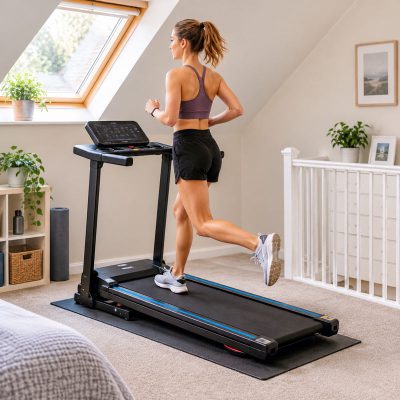
When the weather turns cold and wet, having a treadmill at home becomes a tempting option. You can fit in a walk or a run without worrying about dark evenings, muddy pavements or another spell of heavy rain.
For many households, the obvious place to put one is an unused spare bedroom. It keeps the ground floor free and gives you somewhere to exercise without taking over the living room. But before carrying a treadmill upstairs, there are a few things worth checking.
A treadmill is a fairly heavy piece of equipment, and using one creates repeated impact as well as noise and vibration. The suitability of an upstairs room depends on more than whether the machine will physically fit.
1. Can Your Upstairs Floor Support a Treadmill?
Start with the floor itself. A treadmill’s weight is only part of the equation. You also need to account for the person using it and the repeated impact created while walking or running.
For example, an 80kg treadmill carrying a 90kg user puts around 170kg of combined weight on the floor. During exercise, however, the load is not entirely static. Each foot strike creates additional force, which is transferred through the machine into the floor.
Does the type of floor matter?
Many UK homes have suspended timber floors upstairs, while others have concrete or different forms of floor construction. They can respond differently to weight and movement.
Timber floors may have some natural flexibility, particularly in older properties or rooms with longer unsupported spans. That does not automatically make them unsuitable for a treadmill, but noticeable bouncing or movement deserves attention. Concrete floors may feel more solid, although their actual load capacity still depends on the building’s construction.
The important point is that you cannot judge structural strength simply by looking at the floor. The size, spacing and condition of the supporting joists, along with the distance between supports, all matter.
If the floor already feels unusually springy, the property is older, or you simply do not know how the floor is constructed, avoid guessing. A suitably qualified building professional or structural engineer can assess whether it is appropriate for the equipment.
2. Noise and Vibration: What About the Room Below?
Even when the floor is structurally suitable, noise can be an issue.
The motor produces some sound, but the repeated impact of footsteps can be more noticeable downstairs. Vibration may travel through the floor structure, particularly in homes with suspended timber floors.
Think about a treadmill in a spare bedroom above the living room. You might be happy exercising with headphones on, but someone downstairs could hear a regular thudding noise with every step. Early morning or late evening workouts can make this more of a problem.
Can a treadmill mat help?
A proper treadmill mat is worth considering. It helps protect the floor from scratches and pressure marks, while reducing some of the vibration transmitted through the machine’s feet.
It will not eliminate all noise, though. Sound travelling through the building structure is difficult to prevent completely, so a mat should not be treated as a guaranteed solution.
Also check that the treadmill is level and properly maintained. Loose components or worn parts can create unnecessary noise, while an unstable machine may make vibration worse.
If you live above another household, it is worth thinking about their daily routine before deciding when and where to exercise.
3. Is Your Upstairs Room Suitable for a Treadmill?
Once the floor and noise questions have been considered, look at the room itself. A treadmill might fit on the floor plan but still be uncomfortable or awkward to use.
Ceiling height is particularly important in older homes and converted loft rooms. You need enough headroom to stand and move naturally on the running deck, allowing for the extra vertical movement when running. A room that feels fine for walking may become uncomfortable at a faster pace.
Space around the machine matters just as much. Check the manufacturer’s recommended clearance, especially behind the running deck and around the sides. You should be able to get on and off safely without squeezing past furniture.
It is also worth checking the practical details. Is there a suitable power socket nearby? Can the room be ventilated properly? Will the treadmill block access to a window, wardrobe or doorway?
And do not forget the staircase. Large treadmills can be difficult to manoeuvre around tight corners and narrow landings. Check the packaged dimensions and weight before ordering, and find out whether the machine can be assembled in the room.
Would a folding treadmill be a better option?
If the room also needs to function as a guest bedroom or home office, a folding treadmill can make better use of the available space. Raising the running deck after a workout frees up some floor area without needing to move the machine elsewhere.
Just bear in mind that folding the treadmill does not reduce the load on the floor while it is being used. The same structural and vibration considerations still apply.
4. If You’re Renting, What Should You Check First?
For tenants, there are a few additional things to consider before bringing a treadmill into an upstairs room.
Start by checking your tenancy agreement for any conditions relating to heavy equipment, floor protection, property alterations or noise. If the wording is unclear, ask your landlord or letting agent rather than assuming it is fine.
This is particularly relevant in a maisonette, split-level flat or upstairs flat where another household may live directly below.
Even if the treadmill fits comfortably in your bedroom, repeated footfall could become an issue for downstairs neighbours. Consider when you normally exercise and whether the floor construction is likely to transmit much noise.
Floor protection is another practical concern. Treadmill feet can leave pressure marks on carpets or damage laminate flooring, especially if the machine moves slightly during use. A suitable mat can help protect the surface, although it is important to check that it is appropriate for both the treadmill and the flooring underneath.
If you are unsure about the floor’s suitability or need to make any permanent changes, discuss it with the landlord before installation. Sorting things out beforehand is much easier than dealing with damage or complaints later.
Choosing a Treadmill That Works in Your Home
An upstairs room can be a convenient place for a home treadmill, particularly when ground-floor space is limited. The key is to look beyond the available floor area and consider the building, the people living below and how the equipment will fit into your daily routine.
It is also worth choosing a machine that matches the space you have. A large treadmill with features you rarely use may not be the most practical choice for a spare bedroom. A compact or folding model could make more sense, provided it offers the running space and features you need.
Home Pet Essentials stocks a range of home fitness equipment, including treadmills for different workout needs and living spaces. Measuring the room and checking the practical requirements before choosing a model will help you find something that fits your home as well as your fitness routine.