

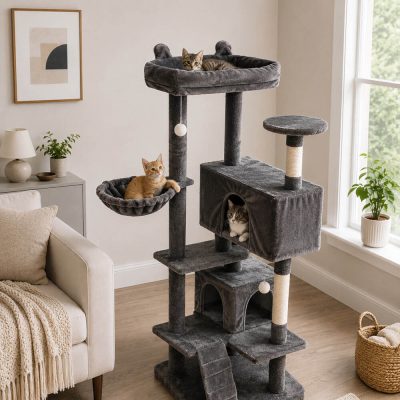
Have you ever bought your cat a lovely new cat tree, put it together, found what seems like the perfect spot, and then watched your cat completely ignore it?
Perhaps you chose a quiet corner of the house. Maybe you even put it in a spare room where nobody would disturb them. It seemed like the considerate thing to do.
And yet, your cat would rather sit on the back of the sofa, climb onto a windowsill or curl up on top of a cupboard.
If that sounds familiar, you may have started questioning the cat tree itself. Is it too small? Is the material wrong? Is the scratching post too short? Perhaps your cat simply does not like cat trees.
Before replacing it, though, take another look at where you put it.
The location of a cat tree can make a surprisingly big difference to whether a cat actually uses it. Cats have their own ideas about what makes a good place to sleep, watch, hide and climb, and those ideas do not always match ours.
Cats Don’t Necessarily Want a Quiet Room
When people think about the ideal place for a cat tree, a quiet, unused room often comes to mind.
It is peaceful. There is plenty of space. Nobody is constantly walking past. Surely a cat would appreciate that.
But cats are not necessarily looking for somewhere completely isolated.
They are territorial animals. Even a relaxed house cat likes to know what is happening within its surroundings. They may spend a surprising amount of time watching people, listening to sounds and keeping an eye on changes around the home.
That is one reason a cat may ignore an expensive cat tree in an empty room but happily spend hours sitting on a chair in the middle of the living room.
The chair may not be particularly comfortable. It may not even belong to them.
But from there, they can see everything.
For a cat, that can be far more valuable.
So Where Should You Put a Cat Tree?
There is no single perfect location for every cat. Your cat’s personality, age and habits all matter.
However, there are a few places that tend to make more sense than simply choosing the quietest corner available.
Near a Window
A window can turn a cat tree into much more than a place to sleep.
From a raised position near a window, a cat may be able to watch birds, passing people, moving cars, leaves blowing in the wind or simply changes in the garden.
Even indoor cats have plenty to observe.
My own preference would be to give a cat access to a window with something genuinely interesting outside, rather than placing the cat tree beside a window that looks directly onto a blank wall.
Of course, you also need to consider the practical side. Make sure the cat tree is stable, cannot tip towards the window and does not obstruct a safe route around the room.
If your cat spends half the afternoon sitting on the windowsill, that is a fairly strong clue that they value the location.
A cat tree placed nearby can give them the same view while providing a more suitable elevated resting spot.
Near Family Activity
This is where the idea of a “quiet place” can become misleading.
Cats often want to be close to their people without necessarily wanting to be handled.
There is a big difference between being in the middle of family life and being in the middle of family life.
A cat tree beside the sofa, for example, can give a cat the option to stay near you while remaining comfortably out of reach.
You might be watching television, reading, working on a laptop or talking to someone. Your cat can sit nearby, watch what you are doing and still have its own space.
That is often a much more attractive arrangement than putting the cat tree in a room that nobody uses.
Think of it as giving your cat a front-row seat rather than sending them backstage.
Somewhere With a View
Height matters to cats.
Walk into almost any home with a cat, and you will probably find evidence of this. The top of the wardrobe becomes a favourite sleeping spot. The back of the sofa suddenly seems fascinating. A shelf that you never thought about becomes prime real estate.
There is a reason for this.
Being higher up gives cats a better view of their surroundings. It can help them monitor movement without being directly involved in it.
This is particularly useful in busy homes. Children may be running around, visitors may come and go, and other pets may be moving through the house. A raised position gives a cat some distance while still allowing them to see what is happening.
That is one of the biggest advantages of a properly positioned cat tree.
You are not simply giving your cat somewhere to climb.
You are giving them a vantage point.
Somewhere They Can Observe Without Being Disturbed
There is another detail that is easy to miss.
Cats often want to observe activity without becoming part of it.
Imagine placing a cat tree directly beside a busy doorway. Your cat may have a good view, but people constantly walking past could make the position uncomfortable.
Likewise, putting it right next to a loud television or in an area where children frequently play may not give your cat the sense of security they are looking for.
A better position might be slightly away from the main flow of traffic.
The cat can see the room, hear what is going on and remain part of the household, but nobody is constantly brushing past them.
That balance is important.
Think Like a Cat, Not Like a Furniture Planner
This may sound obvious, but it is surprisingly easy to choose a cat tree location based on how the room looks rather than how the cat uses it.
We see an empty corner and think:
“That’s the perfect place for the cat tree.”
Your cat sees an empty corner and may think:
“There is absolutely nothing to look at here.”
Instead of starting with the furniture, start with your cat.
Where do they already spend time? Sitting on the windowsill? Watching you from the hallway? Sleeping on the back of the sofa? Climbing onto high furniture?
Or, do they regularly sit somewhere where they can see both the room and the entrance?
These habits tell you quite a lot.
If your cat repeatedly chooses a particular spot, there is probably a reason.
Cats Like Having a Territory They Can Observe
A cat does not need to patrol the house dramatically to have a sense of territory.
They may simply observe.
From a high position, a cat can keep track of people, other animals and changes in the environment. It gives them a sense of control over their immediate surroundings.
This is particularly relevant in multi-cat households.
A raised cat tree can provide a place where one cat can retreat without completely disappearing. It can also help create different levels within the home, giving cats more opportunities to avoid unwanted interactions.
Of course, a cat tree is not a solution to serious conflict between cats. But providing more usable spaces can make the home environment more flexible.
And flexibility matters when several animals are sharing the same territory.
What If Your Cat Still Doesn’t Use the Cat Tree?
Don’t immediately assume you’ve bought the wrong one.
First, watch what your cat actually does.
If they prefer sleeping in dark, enclosed places, a very open cat tree may not appeal to them.
If they spend their day watching birds through the window, putting the cat tree on the other side of the room probably won’t change that.
If they like being near you, moving their cat tree into a completely unused room could make it less attractive.
Sometimes a small change in position is enough.
You could move it closer to a window, place it beside the sofa, or position it somewhere that gives your cat a clear view of the room.
It can also take a little time. Some cats investigate new furniture immediately. Others treat anything unfamiliar with considerable suspicion.
And if you’ve ever bought a cat an expensive toy only for them to spend an hour playing with the cardboard box it came in, you already know that cats do not always follow our plans.
Don’t Forget About Stability
There is one practical issue that should never be overlooked when choosing a location.
A cat tree needs to feel secure.
Cats climb, jump and move quickly. If the structure wobbles every time they jump onto a platform, they may simply decide that it is not worth using.
The floor should be reasonably level, and the cat tree should be positioned where your cat can approach and leave it comfortably.
If you are putting one near a window or against furniture, make sure there is enough clearance for your cat to move safely.
A good location should offer three things at the same time:
A useful view, a sense of security and easy access.
Get those right, and the cat tree becomes part of the environment rather than an isolated piece of pet furniture.
Your Cat Tree Doesn’t Have to Be Hidden Away
There is a common idea that cat furniture should be tucked into a corner where it does not interfere with the room.
From a human point of view, that makes sense.
But your cat may prefer the opposite.
A cat tree can work surprisingly well beside a sofa, near a window or in a part of the room where the family spends most of its time.
It does not mean your cat wants constant attention. Quite often, they want the ability to choose.
They can climb up, watch what everyone is doing, have a nap and leave whenever they feel like it.
That sense of choice is part of what makes a good cat environment.
The Best Location Is Often the Place Your Cat Has Already Chosen
If there is one thing worth remembering before moving your cat tree, it is this:
Watch your cat first.
You may have spent hours thinking about the quality of the scratching posts, the materials, the size of the platforms and whether the design will fit your home. Those things certainly matter.
But even a well-made cat tree can be ignored if it is placed somewhere your cat finds boring, exposed or disconnected from the rest of the home.
Cats are territorial animals. They also naturally make use of height to observe their surroundings.
Give them somewhere elevated where they can see what is happening, stay close to the people they trust and retreat without being disturbed, and you are much more likely to create a space they actually want to use.
Sometimes the problem isn’t the cat tree.
It is the view.
If you’re looking for a practical cat tree for your home, Home Pet Essentials has an option designed to give cats dedicated climbing, scratching and resting space without requiring a huge amount of floor space.
The trick is not simply buying more things for your cat. It is understanding how they use the space you already have, then giving them a reason to use it.