

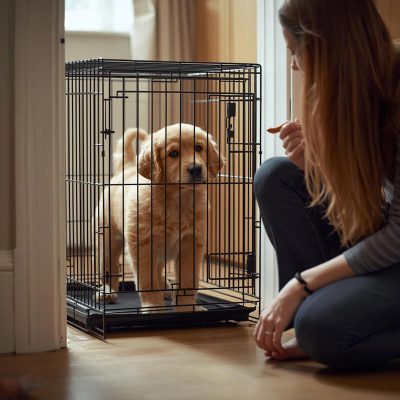
There’s a moment many UK dog owners know all too well. You’ve set up the crate, added a soft blanket, maybe even a toy or two—and the second your dog realises what’s going on, they plant their paws, back up, or give you that look: “Absolutely not.”
If your dog hates the crate, you’re not alone. And more importantly, it doesn’t mean you’ve done anything wrong.
Let’s walk through what’s really going on, why this reaction is completely natural, and how to turn things around—without stress, force, or guilt.
Why do some dogs resist the crate?
Dogs aren’t born loving crates. In fact, many see them as:
- A restriction of freedom
- A strange, unfamiliar space
- Or worse, a place they’ve been sent when something “bad” happened
So if your dog avoids the crate, cries, or refuses to go in, that’s not stubbornness—it’s instinct.
That said, in many homes across the United Kingdom, crates are incredibly useful when introduced properly. If you live in a small flat in London or spend your weekends dodging the drizzle in Manchester, you know how easy it is for your dog to get underfoot—or into mischief—when the weather keeps you both indoors. In these typical UK situations, having a crate can offer both structure and a safe retreat for your dog.
Why crate training actually matters
Crates aren’t about confinement—they’re about structure and safety.
In a typical UK household:
- Homes can be compact
- Dogs often stay indoors on rainy days
- Owners juggle work-from-home and time out
A well-trained crate can help with:
- Toilet training
- Preventing destructive behaviour when you’re out
- Creating a safe, calm space for your dog
- Managing overnight routines
When done right, a crate becomes less like a “cage” and more like a bedroom your dog chooses to use.
Small dogs vs large dogs: training approaches that actually work
Not all dogs respond the same way. Size, temperament, and energy levels all play a role.
Small dogs
Small dogs are often:
- More sensitive
- More prone to separation anxiety
- More vocal when stressed
What works best:
1. Make it cosy
Use:
- Soft bedding
- A familiar-smelling blanket
- A small toy
The goal is to make the crate feel like a safe nest, not a cold space.
2. Keep sessions short and positive
Start with:
- 2–5 minutes inside
- The door opens at first
Reward calm behaviour, not just entry.
3. Stay nearby at the beginning
Small dogs often panic if left alone too quickly. Sit nearby, read, or work—just be present.
Medium to large dogs
Larger dogs are usually:
- More energetic
- More independent
- Sometimes, more physically resistant
What works best:
1. Exercise before crate time
A tired dog is a cooperative dog.
- Walk
- Play
- Mental stimulation
Then introduce the crate.
2. Use food as a bridge
Feed meals inside the crate.
This builds a simple association:
→ crate = good things happen here
3. Build duration gradually
Start small:
- 5 minutes → 10 → 20 → longer
Avoid jumping straight to long periods.
The biggest mistake: moving too fast
Most crate resistance comes from one issue:
→ Trying to rush the process
Common scenario:
- The dog refuses the crate
- Owner insists
- Dog panics
- Crate becomes “the bad place”
Once that association forms, it’s harder to fix.
What if your dog already hates the crate?
This is the “tough but fixable” situation.
If your dog:
- Barks or cries non-stop
- Refuses to enter
- Tries to escape
- Shows stress
→ You need a reset approach
Step 1: Remove pressure completely
For a few days:
- Leave the crate open
- Don’t force entry
- Don’t close the door
Let your dog explore it on their own terms.
Step 2: Rebuild the association
Make the crate a reward zone:
- Treats appear inside
- Toys are only available there
- Praise happens near it
No pressure, just positive exposure.
Step 3: Reintroduce structure slowly
Once your dog starts entering willingly:
- Close the door briefly (seconds)
- Open before they react
- Gradually extend the time
Step 4: Stay calm
Dogs read you.
If you’re tense, frustrated, or rushed, they pick it up instantly.
What you should NEVER do
Some methods might seem like “tough love,” but they backfire badly.
🚫 Never force your dog into the crate
This creates fear, not compliance.
🚫 Never use the crate as punishment
If the crate = bad behaviour → your dog will avoid it.
🚫 Don’t ignore extreme distress
A bit of whining is normal.
Full panic (howling, frantic behaviour) is not.
🚫 Don’t leave too long, too soon
Especially for puppies:
- Too much time → anxiety → negative association
A few beginner-friendly FAQs
1. How long can a dog stay in a crate?
It depends on age and training.
- Puppies: 2–4 hours max
- Adult dogs: 4–6 hours
Longer periods should be occasional, not a daily routine.
2. Should I cover the crate?
Sometimes, yes.
Covering can:
- Reduce visual stimulation
- Help anxious dogs relax
But:
- Ensure good airflow
- Monitor your dog’s reaction
3. What if my dog cries at night?
This is very common.
Try:
- Placing the crate near your bed initially
- Gradually increasing distance over time
Avoid rushing straight to isolation.
Turning the crate into a “yes” space
When crate training works, something shifts.
Your dog:
- Walks in voluntarily
- Lies down calmly
- Sees it as their own space
That’s the goal—not obedience, but comfort.
A final perspective
Dogs don’t hate crates—they hate what the crate represents to them.
Change that meaning, and everything changes.
With patience, consistency, and the right setup, even the most stubborn crate-hater can learn to feel safe, settled, and secure.
At Home Pet Essentials, the focus has always been on creating a more comfortable home—not just for people, but for every member of the family, including the four-legged ones. Because a calm dog doesn’t just make life easier—it makes home feel complete.