

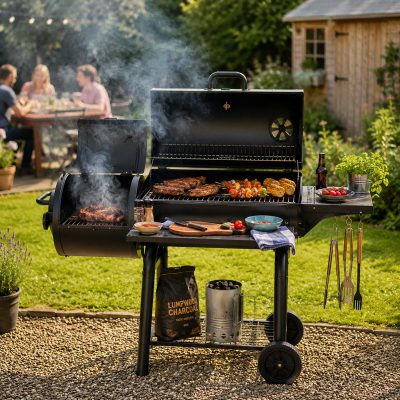
There is something about a charcoal BBQ that makes a garden gathering feel a little more relaxed. You can smell the smoke before the food is ready, someone is usually hovering around asking when the burgers are going on, and there is always at least one person who insists they are perfectly happy standing outside although the British weather has just changed its mind.
For many of us, that is part of the fun.
But charcoal BBQs are not all built around the same style of cooking. A straightforward charcoal grill is ideal for getting burgers and sausages on the table without making life complicated. A multi-function charcoal BBQ with a side smoker and dual-zone cooking gives you much more room to experiment. Then there is the Kamado, with its thick ceramic body and impressive heat retention, which is almost in a category of its own when it comes to outdoor cooking.
Having used and looked at different styles of BBQ over the years, I think the interesting part is not deciding which one is “best”. Each has its own personality, and the differences become much clearer once you think about how you actually spend a Saturday afternoon in the garden.
Standard Charcoal BBQ
There is a reason the traditional charcoal BBQ remains so popular. It is simple and familiar, and it does exactly what most people expect a BBQ to do.
Light the charcoal, give it time to heat up, get the cooking grate ready and start grilling.
For a casual family BBQ, that simplicity is hard to beat. If the plan is burgers, sausages, chicken thighs and perhaps a few vegetable skewers, there is not much need for anything more complicated. You can get the coals going, cook everything over direct heat and spend more time talking to your guests rather than worrying about what is happening inside the BBQ.
That is particularly welcome when you have six hungry people standing around waiting for their food.
Straightforward Direct Grilling
A standard charcoal grill is mainly designed for direct cooking. Food is placed above the hot charcoal, giving you the familiar smoky flavour and those slightly charred edges that are such a big part of a traditional BBQ.
It works particularly well for:
- Burgers and sausages
- Steaks
- Chicken wings and thighs
- Kebabs and vegetable skewers
- Corn on the cob
- Other quick-cooking BBQ favourites
There is also something satisfying about the hands-on nature of it. You can move the food around the grill, add more charcoal when needed and adjust your cooking as you go.
It is not trying to be an outdoor oven or a dedicated smoker. It is simply a charcoal BBQ, and for many people, that is precisely the point.
Where a Basic Grill Starts to Feel Limited
The limitations tend to appear when you want to cook different foods in different ways.
Suppose you have chicken that needs a slower, gentler cook, but you also want to sear some steaks over high heat. On a basic grill, you can move the charcoal around to create hotter and cooler areas, but the amount of control you have is still fairly limited.
Smoking is possible too, but it is not really what a standard open grill is designed for. You can experiment with wood chips and indirect heat, but if smoking becomes a regular part of your BBQ routine, you may eventually want something more specialised.
For occasional garden BBQs, though, this straightforward approach can be more than enough.
Multi-Function Charcoal BBQ
A multi-function charcoal BBQ takes the familiar charcoal grill and gives you considerably more options.
The exact design varies, but models with a side smoker and dual-zone cooking are particularly interesting because they allow you to combine different cooking methods in one BBQ.
This is the sort of grill that starts to make sense when BBQ cooking becomes more than simply putting food over hot coals.
The Side Smoker Adds Another Dimension
The side smoker is perhaps the most obvious difference.
Instead of cooking everything directly above the charcoal, you can use the separate smoking chamber for slower cooking and let the smoke gradually work its way into the food.
This is where you can start experimenting with ribs, pulled pork, brisket or smoked chicken. You are no longer limited to food that can be cooked quickly over a hot grill.
There is a bit more to think about, naturally. You need to manage the charcoal and airflow, and keeping a steady temperature takes some practice. But that is also where a lot of the enjoyment comes from.
One of the nice things about smoking is that it changes the rhythm of a BBQ. Rather than rushing to get everything cooked before people start asking questions, you can start preparing food hours earlier and let the BBQ do its thing in the background.
It is quite common to find yourself checking the temperature, having a cup of tea, going back to check the smoke, and then somehow spending far longer outside than you originally intended.
Dual-Zone Cooking Is More Useful Than It Sounds
The term dual-zone cooking can sound like a bit of BBQ jargon, but the principle is actually very straightforward.
You create two different heat areas. One side is hotter and suitable for direct grilling, while the other is cooler and can be used for indirect cooking.
This becomes particularly useful when you are cooking for a group.
Steaks might need a good blast of direct heat, while chicken needs more time at a lower temperature. You can cook the steaks over the hotter zone and let the chicken finish more gently on the cooler side.
You can also sear meat over direct heat before moving it away from the charcoal to finish cooking. Once you get used to working with the two zones, you spend less time moving charcoal around and more time actually cooking.
For a larger family BBQ or a garden gathering with friends, this flexibility can make a noticeable difference.
A Better Fit for Longer BBQ Sessions
A multi-function charcoal BBQ is particularly well suited to people who enjoy experimenting.
You might have sausages and burgers cooking directly over the coals while something else is smoking slowly in the side chamber. Or you could spend a Sunday afternoon cooking a larger piece of meat, then use the main grill for vegetables and smaller items later in the day.
It is a more involved way of cooking, but it gives you plenty of room to play around.
The downside is that these BBQs tend to be larger and take up more space. In a typical UK garden, that is worth considering. Once you have allowed room to open the smoker, move around the BBQ and safely handle hot charcoal, the footprint can be considerably bigger than it first appears. A useful tip is to measure the area on your patio or in your garden where you plan to place the BBQ before you buy. This helps you avoid surprises and makes it easier to choose a grill that genuinely fits your available space.
For someone who regularly hosts BBQs, that extra space may be well worth it. For someone who only cooks outside a few times each summer, it might be more BBQ than they actually need.
Kamado Grill
The Kamado is still powered by charcoal, but it feels very different from a conventional BBQ.
The thick ceramic body is the first thing you notice. It is heavy, solid and built to retain heat. Once you have used one for a while, you start to appreciate that it is less like an open grill and more like a highly insulated outdoor oven for cooking.
Heat Retention Makes a Real Difference
The biggest strength of a Kamado is its ability to hold a stable temperature.
Once the grill has reached the temperature you want, the ceramic construction helps retain the heat, while the vents allow you to control the airflow and adjust the cooking temperature.
This is particularly useful for low-and-slow cooking.
If you have ever spent several hours cooking pulled pork, you will know that keeping the temperature reasonably steady is one of the most important parts of the process. A Kamado is well suited to this because it can maintain a consistent cooking environment for long periods.
There is a learning curve, though.
A Kamado is not something you necessarily want to keep opening and adjusting every few minutes. Small changes to the vents can take time to have an effect, and if you let the temperature climb too far, bringing it back down can take patience.
Once you understand how the airflow works, however, it becomes much easier to manage.
More Than a Grill
The other thing that makes a Kamado interesting is its versatility.
With the right setup, you can use it for:
- High-temperature grilling
- Slow cooking
- Smoking
- Roasting
- Baking
- Pizza
That makes it particularly appealing if you enjoy trying different things in the garden.
One weekend, you might use it for a quick batch of burgers. The next, you could spend most of the day cooking pulled pork. Another time, you might roast a chicken or have a go at homemade pizza.
The cooking environment is quite different from a standard charcoal grill. Because the heat is contained within the ceramic body, you can create a more controlled atmosphere rather than simply cooking food directly over the coals.
There is also something quite enjoyable about the slower pace. On a warm Sunday, getting the Kamado going in the morning and knowing that dinner is going to take several hours can feel less like cooking a meal and more like having a project in the garden.
Three BBQs, Three Very Different Ways to Spend a Weekend
The differences between these grills become much easier to understand when you put them into real situations.
A Quick Saturday Afternoon BBQ
For a simple afternoon BBQ, the standard charcoal grill is often the obvious choice.
You light the charcoal, cook burgers and sausages, perhaps throw a few chicken skewers on the grill, and you are done.
There is no reason to bring a more complicated setup into the picture if you do not need it.
A multi-function charcoal BBQ can obviously handle the same food, but you may not need the smoker or multiple cooking zones for a quick meal.
A Kamado can also grill perfectly well, although its real strengths tend to become more noticeable when you take advantage of its ability to control temperature and cook for longer periods.
A Family Gathering or Garden Party
This is where the multi-function charcoal BBQ starts to earn its keep.
When you are cooking for several people, the problem is rarely just getting the food hot enough. It is getting everything ready at roughly the same time.
Someone wants their steak well done. Someone else wants theirs rare. The chicken needs longer. The vegetables are nearly ready, but the burgers are taking up half the grill.
Having separate cooking zones makes that juggling act considerably easier.
The side smoker adds another option if you have planned. You can have something cooking slowly before your guests arrive, then use the main grill for food that needs to be cooked fresh.
That kind of flexibility is particularly handy when a BBQ turns into an all-afternoon affair.
A Slow Sunday Cook
The Kamado feels most at home here.
There is a certain satisfaction in starting the charcoal earlier in the day, getting the temperature settled and then letting a piece of meat cook slowly while you get on with other things.
It is not the fastest approach, and that is exactly why many people enjoy it.
A slow Sunday cook gives you time to experiment with rubs, wood chunks and different cooking temperatures. You can check the temperature every so often, make small adjustments and gradually get a feel for how your Kamado behaves.
It is the kind of cooking that rewards patience.
When You Want to Experiment with Smoking
Both the Kamado and the multi-function charcoal BBQ are capable of producing excellent smoked food, but the experience is different.
The Kamado creates a contained, insulated cooking environment that is well suited to maintaining a steady temperature over a long period.
The multi-function BBQ, on the other hand, gives you a dedicated side smoker alongside the main charcoal grill. This makes it particularly appealing if you like switching between traditional grilling and smoking during the same cooking session.
Neither approach is necessarily better. They simply give you different ways to work with smoke and charcoal.
Space, Weight and Storage
It is easy to get caught up in cooking features and forget about the physical reality of having a BBQ in a UK garden.
Space can be surprisingly important.
A standard charcoal grill is usually the easiest to accommodate. It can be positioned on a patio or suitable outdoor surface without taking over too much of the garden.
A multi-function charcoal BBQ needs more room, particularly if it has a side smoker. You need enough space to open the different sections comfortably and move around the BBQ while cooking.
A Kamado has a smaller footprint than some large multi-function grills, but it is extremely heavy. Once it is in position, you are unlikely to want to move it very often.
That is something I would consider carefully before setting one up. A BBQ that looks perfectly manageable in a product photo can feel rather different when you are trying to move it across a patio.
Storage is another consideration. The British climate is not always kind to outdoor equipment, so thinking about where the BBQ will live when it is not being used is sensible. A proper cover is useful for all three types, but the size and weight of the grill can make a difference when you are trying to protect it over the winter.
Simple Cooking or a New Hobby?
There is also a difference in how much involvement each BBQ demands.
The standard charcoal grill is the easiest to get to grips with. You learn how to light charcoal, manage the heat and cook directly over the coals. Most people can get comfortable with it fairly quickly.
A multi-function charcoal BBQ gives you more to think about. You start learning about direct and indirect heat, how to arrange charcoal for different cooking zones and how to manage the side smoker.
The Kamado is slightly different again. It rewards you for understanding airflow and temperature control. Once you learn how your particular grill responds, you can become remarkably precise with it, but getting there takes a bit of practice.
For some people, that learning process is half the appeal.
BBQ cooking can easily become a hobby in its own right. You start with burgers, then try ribs, then smoked chicken, then suddenly you are researching different types of wood for smoking at eleven o’clock on a Sunday evening.
That is when a BBQ stops being just another garden appliance and starts becoming something you genuinely enjoy using.
Looking at the Three Styles Side by Side
The standard charcoal BBQ is all about simplicity. It is straightforward, familiar and well suited to traditional direct grilling. For burgers, sausages, steaks and the occasional summer BBQ, it can do everything you realistically need.
The multi-function charcoal BBQ is more flexible. A side smoker gives you the option of low-and-slow cooking, while dual-zone cooking makes it easier to manage different foods and temperatures at the same time. It takes up more space and requires a little more attention, but it gives you plenty of room to experiment.
The Kamado grill offers a more controlled style of charcoal cooking. Its thick ceramic construction and excellent heat retention make it particularly good for slow cooking and smoking, while its ability to reach high temperatures means it is equally capable of serious grilling and roasting.
What I find most interesting is that these three BBQs are not really competing for the same kind of user.
A standard charcoal grill makes sense when you want to keep things simple and enjoy a classic BBQ without too much fuss. A multi-function model suits the person who enjoys having several cooking options available at once. The Kamado is for those who are happy to spend more time learning the grill and exploring what charcoal cooking can actually do.