

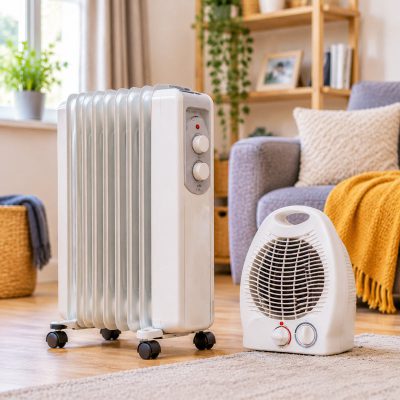
When the temperature drops in the UK, keeping your home comfortable can become a bit of a balancing act. You might want to warm up a cold bedroom before getting dressed, take the chill off your home office or keep the living room cosy on a winter evening. Turning on the central heating for every little change in temperature isn’t always necessary, which is where a portable electric heater can come in handy.
Two common options are oil-filled radiators and fan heaters. Both provide extra heat using electricity, but they deliver it in different ways. One gradually warms the room and retains heat, while the other blows warm air out almost immediately.
Neither is the right choice for every situation. The best option depends on the size and condition of your room, how long you need heating and how quickly you want to feel warmer. Here’s what to consider before choosing one.
How Do Oil-Filled Radiators and Fan Heaters Work?
Although both appliances use electricity to generate heat, their heating methods are quite different.
How Does an Oil-Filled Radiator Work?
An oil-filled radiator uses an electric heating element to warm a special heat-transfer oil sealed inside the unit. The heated oil circulates through internal channels, transferring heat to the metal fins on the outside.
These fins gradually warm the surrounding air. As warm air rises, cooler air moves towards the radiator and is heated in turn. This natural circulation helps distribute heat around the room without a fan.
The oil isn’t burned or used up. It remains sealed inside the appliance and acts as a medium for transferring and storing heat, so there’s no need to refill it during normal use.
Because the oil and metal fins take time to warm up, the heater doesn’t provide instant heat. However, they also retain some warmth after the heating element switches off, allowing the radiator to continue releasing heat as it cools.
How Does a Fan Heater Work?
A fan heater works more directly. It draws cooler air in, passes it over an electrically heated element and blows the warm air back into the room.
You can usually feel the heat within moments of switching it on. Many models also offer adjustable heat settings, a thermostat or an oscillating function to spread warm air over a wider area.
Unlike an oil-filled radiator, a fan heater doesn’t store much heat. Once it is switched off, the supply of warm air stops, although the room will retain some of the heat already released.
Key Differences: Heat, Comfort and Convenience
Understanding how each heater works makes it easier to see where its strengths lie. The difference isn’t simply about which one gets hotter; it’s about the type of warmth and convenience each provides.
Oil-Filled Radiators
Oil-filled radiators are well suited to situations where you want a steady supply of warmth over a longer period.
Their quiet operation is a major advantage. Without a fan running in the background, they’re a good option for bedrooms, living rooms and home offices where noise can become distracting.
The gradual release of heat also makes the temperature feel more consistent once the room has warmed up. Even after the heating element switches off, the radiator continues releasing stored heat for a while.
There are a few drawbacks. They take longer to warm up than fan heaters and are often heavier, although many portable models have castors to make moving them easier. Their metal surfaces can also remain hot after use, so keep children and pets at a safe distance until the unit has cooled.
Fan Heaters
The main advantage of a fan heater is speed. It starts blowing warm air almost immediately, making it useful when you walk into a cold room and want to feel warmer without waiting.
Most models are compact and lightweight, so they’re easy to move between rooms. The directed airflow can also be useful when you want to warm a particular area rather than wait for the whole room to heat up.
The trade-off is that the fan produces some background noise, and the airflow may feel uncomfortable if it blows directly towards you for long periods. Once switched off, the heater provides little residual warmth, so it is less suited to maintaining a steady temperature over several hours.
Which Heater Is Best for Different UK Homes and Rooms?
British homes vary considerably. A modern flat with good insulation has very different heating requirements from an older terraced house with draughty windows and high ceilings.
It’s worth thinking about how each room is used, rather than choosing a heater based on its power rating alone.
Small Bedrooms and Box Rooms
Smaller bedrooms and box rooms are common in UK homes. If you only need extra warmth while getting dressed in the morning or before going to bed, a fan heater can be a convenient choice. It provides heat quickly without needing to run for long.
For a bedroom that needs to stay comfortable throughout the evening, an oil-filled radiator may be more suitable. Its quiet operation is particularly useful if you prefer a peaceful environment.
Remember that room size isn’t the only consideration. A small bedroom with an exposed outside wall or poorly sealed windows may lose heat faster than a larger, well-insulated room.
Living Rooms and Larger Spaces
The living room is often where people spend the most time during colder months. If you’re watching television, reading or relaxing on the sofa for several hours, an oil-filled radiator can provide a comfortable source of supplementary heat without the noise of a fan.
A fan heater is useful when you first enter a cold room and want a quick boost of warmth, particularly if you’re only staying for a short time.
Open-plan living areas need more consideration. When the lounge, dining area and kitchen share one large space, heat can spread over a much wider area. A small portable heater may struggle to warm the entire space evenly, so it’s often more practical to focus on the area where people are actually sitting.
Home Offices and Study Rooms
If you work from home, sitting in a cold room for several hours can quickly become uncomfortable.
An oil-filled radiator is generally a good choice for a home office used throughout the day. It operates quietly and doesn’t blow warm air directly towards your face while you’re working.
A fan heater makes more sense if you only use the room occasionally or need a quick warm-up before starting work. It can also be useful for taking the chill off a small study during short periods of use.
If your desk is close to a window or an outside wall, check for draughts as well. A heater may struggle to keep the area comfortable if cold air is constantly entering the room.
Older Homes and Draughty Rooms
Older British properties can be harder to heat, particularly where there are gaps around windows and doors, solid walls or poor insulation.
A fan heater can make you feel warmer quickly, but it won’t solve the problem of heat escaping from the room. An oil-filled radiator provides a more gradual supply of warmth, but it will also need to work harder if the room loses heat quickly.
In these situations, improving insulation and reducing draughts can be just as important as choosing the heater. Simple measures such as fitting draught excluders, sealing suitable gaps around windows and closing curtains after dusk can help a room retain warmth.
Which Heater Uses Less Electricity?
Running costs are an important consideration, particularly when energy bills are a concern. It’s often assumed that oil-filled radiators are cheaper to run because they retain heat after being switched off. However, this doesn’t tell the whole story.
Both appliances use electrical resistance heating, converting electricity into heat. At the same power rating, they consume broadly the same amount of electricity when operating at full power for the same length of time.
For example, consider two heaters rated at 2,000W:
- A 2,000W oil-filled radiator running at full power for one hour uses 2kWh.
- A 2,000W fan heater running at full power for one hour also uses 2kWh.
The difference comes down to how long each heater needs to operate and how effectively it maintains a comfortable temperature.
How to Calculate Running Costs
You can estimate the cost of using an electric heater with a simple formula:
Running Cost = Power in kW × Hours Used × Electricity Rate per kWh
For example, if you have a 2,000W heater, that’s equivalent to 2kW. At an electricity rate of 26p per kWh, running it at full power for two hours would cost:
2kW × 2 hours × £0.26 = £1.04
This is only an example. Your actual electricity rate will depend on your tariff, so check your latest energy bill before calculating your own costs.
An online electricity cost calculator can also help you compare different heater wattages and usage times before buying.
What Affects Actual Electricity Consumption?
In everyday use, a heater doesn’t necessarily run at full power continuously. Many models have an adjustable thermostat that switches the heating element on and off to maintain the selected temperature.
This means the actual electricity consumed over a few hours may be lower than a calculation based on continuous full-power operation.
The main factors to consider are:
- Power rating: A higher wattage heater can produce more heat, but it also uses more electricity when operating at full power.
- Usage time: The longer the heating element runs, the more electricity it consumes.
- Thermostat control: A suitable temperature setting can prevent unnecessary heating.
- Room insulation: Poorly insulated rooms lose heat more quickly and may need more heating to remain comfortable.
Oil-filled radiators don’t automatically save electricity. They retain heat, just as fan heaters aren’t automatically more expensive because they stop producing warm air when switched off. What matters is the total energy needed to keep the room at a comfortable temperature.
Portable electric heaters are generally most useful as supplementary heating for individual rooms. Using one to heat a large, poorly insulated home for long periods can become expensive.
How to Get the Best Results and Save Energy
A suitable heater can make a noticeable difference, but how you use it matters too. A few practical adjustments can help you get more from either type without wasting electricity.
Getting the Most from an Oil-Filled Radiator
Allow time for it to warm up.
Unlike a fan heater, an oil-filled radiator needs time to reach its operating temperature. If you know you’ll be using a room in the evening, switch it on in advance when appropriate, rather than waiting until the room becomes uncomfortably cold.
Use the thermostat sensibly.
Running the heater at its maximum setting all the time isn’t necessary. Choose a comfortable temperature and let the thermostat regulate the heating element. If your model has several power settings, use one that suits the room and conditions.
Leave space around the radiator.
Keep furniture, curtains and other objects away from the heater so that air can circulate freely. Avoid squeezing it into a tight corner where its heat output may be restricted.
Make use of its residual warmth.
The radiator continues releasing heat after the heating element switches off. This can help maintain comfort for a while without further electricity being used to generate heat. However, don’t leave it running longer than necessary simply because it takes time to cool down.
Getting the Most from a Fan Heater
Use it when you need quick warmth.
Fan heaters are particularly useful for short periods. Switch one on when entering a cold room, then turn it off once additional heating is no longer needed.
Position it carefully.
Place the heater on a stable, level surface where warm air can circulate freely. Avoid directing the airflow towards curtains, furniture or anything that could obstruct the outlet.
Keep the air vents clear.
Dust and fluff can build up around the air intake and outlet. Clean the appliance according to the manufacturer’s instructions, and never cover it or place objects against its vents.
Use built-in controls.
If the model has a thermostat or timer, use these features to control how long it operates. Always follow the manufacturer’s instructions, particularly when using timer functions.
Simple Energy-Saving Habits for Both Heaters
Some of the most useful ways to reduce heat loss don’t involve the heater itself.
- Close doors: Keep warmth in the room you’re using instead of allowing it to escape into colder, unused spaces.
- Reduce draughts: Draught excluders and suitable window seals can help prevent cold air entering around doors and windows.
- Use curtains: Open them during the day to make use of sunlight, then close them after dusk to help reduce heat loss through windows.
- Check the temperature: A simple indoor thermometer can help you avoid turning the heater up unnecessarily.
- Ventilate sensibly: Use extractor fans when cooking or showering and ventilate rooms as needed. Heating doesn’t remove moisture from the air, so good ventilation remains important for controlling condensation.
For older people and those who are less mobile or have certain health conditions, maintaining a suitable indoor temperature is particularly important. UK public health guidance commonly recommends keeping rooms used regularly at around 18°C or above for these groups.
Oil-Filled Radiator or Fan Heater: Which Should You Choose?
An oil-filled radiator is a good choice for quiet, steady warmth when you spend several hours in the same room. A fan heater is more convenient when you need quick heat for shorter periods.
Neither is automatically cheaper to run. Compare the wattage, consider how long you’ll use the heater and take account of how well your room retains heat.
At Home Pet Essentials, you can explore our range of portable oil-filled radiators and electric fan heaters to find a suitable option for your home.