

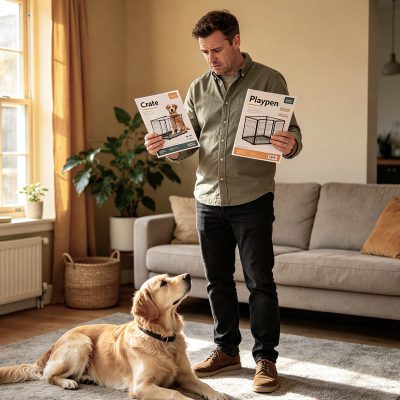
There’s a moment many dog owners know all too well.
You finally bring your puppy home. The bowls are ready. The toys are scattered across the floor. Somebody in the family has already taken about two hundred photos in the first hour. The dog is excited, confused, slightly chaotic, and somehow already acting like they own the house.
Then comes the next question.
Where is the dog actually going to stay?
Not just sleep for the night. Properly stay. Relax. Wind down. Feel safe. Avoid chewing table legs at 2am. Avoid turning the living room into what looks like a tiny indoor hurricane.
This is usually where people start comparing dog crates and dog playpens.
And lately, especially across the UK, the conversation around pet spaces at home has changed a lot. Years ago, most people automatically bought a crate and called it a day. Now, more owners are thinking carefully about comfort, freedom of movement, apartment size, working from home, and how dogs actually feel inside these setups.
If you spend enough time in dog communities online, you’ll notice something interesting.
A growing number of owners quietly admit that their dogs tolerate crates, but genuinely prefer playpens.
Not every dog, of course. Some dogs absolutely love crates and treat them like tiny bedrooms. But many modern pet owners are realising that giving dogs a bit more room often creates a calmer atmosphere at home.
The trade-off is obvious, though.
A playpen takes up space.
Real space.
And in many UK homes, especially terraces, flats, and smaller semi-detached houses, every square metre matters.
That’s why there’s no perfect answer for every dog. The better question is usually this:
What kind of setup actually works for your dog, your home, and your daily routine?
Why Dog Crates Became So Popular
Dog crates exploded in popularity partly because they work extremely well for certain situations.
Dogs naturally seek den-like spaces. A properly introduced crate can feel secure, calming, and predictable. For puppies, especially, crates help create structure very quickly.
That structure matters.
Puppies are adorable, but they are also tiny freelance destruction experts with unlimited energy and absolutely no respect for expensive furniture.
Crates help with:
- toilet training
- bedtime routines
- preventing unsafe chewing
- travel preparation
- reducing overstimulation
For many owners, especially first-time puppy parents, crates create a sense of control during those chaotic early months.
And honestly, sometimes that matters for humans just as much as dogs.
A crate can also become a very useful “off switch” for overstimulated puppies who simply do not know how to settle on their own yet.
Some breeds especially benefit from this kind of structure.
Working breeds like Border Collies, Cocker Spaniels, and Labradors can become overstimulated surprisingly fast indoors, especially as puppies. A quiet crate space often helps them decompress.
Why Some Dogs Truly Love Their Crates
This part is important because crates sometimes get unfairly criticised online.
A properly crate-trained dog is not necessarily unhappy.
In fact, many dogs voluntarily walk into their crates throughout the day.
You will often see:
- dogs sleeping inside with the door open
- dogs retreating there during loud activity
- older dogs using crates as resting spots
- anxious dogs seeking the enclosed feeling
The crate itself is not the problem.
Poor crate use is usually the problem.
When crates are used correctly, they can feel comforting rather than restrictive.
The trouble starts when crates become overused because of convenience.
Dogs are social animals. Keeping them confined for excessively long periods every day can create frustration, stress, boredom, and behavioural issues.
That’s where playpens started becoming much more popular among modern dog owners.
Why More People Are Choosing Playpens Instead
Playpens solve a very specific problem.
They give dogs freedom without giving them total freedom.
That middle ground is extremely useful.
A dog can:
- move around
- stretch properly
- play with toys
- access water
- change sleeping positions
- Stay mentally calmer
For puppies, especially, this can make a massive difference during daytime hours.
Many owners notice their puppy settles faster in a playpen compared to a crate because there’s simply less physical restriction.
This became even more common during the work-from-home era.
People suddenly spent more time observing their dogs throughout the day and realised something interesting:
Some dogs hated being crated for long daytime periods but were perfectly calm inside a playpen.
That extra movement matters more than many people expect.
The Reality of UK Home Sizes
Now comes the practical issue.
UK homes are not exactly famous for enormous open layouts.
A large dog playpen can easily dominate an entire room.
This is where reality hits for many owners.
A Labrador puppy in a spacious playpen setup looks fantastic on Instagram. It feels slightly different when half your living room disappears overnight.
In smaller British homes, setup choices often depend heavily on available floor space.
Flats and apartments
For smaller flats, crates are usually easier to manage practically.
A compact crate:
- fits neatly into corners
- keeps walkways clear
- works well for nighttime sleeping
A playpen in a small flat can quickly make the entire room feel cramped.
Medium-sized family homes
This is where playpens become much more realistic.
Many owners use:
- a crate overnight
- a playpen during the day
This combination actually works extremely well.
Larger homes
In bigger houses, playpens become far easier to integrate naturally into daily life.
Some owners even create dedicated dog zones with:
- beds
- toys
- feeding stations
- calming spaces
At that point, the playpen starts functioning almost like a miniature indoor dog room.
Breed Size Changes Everything
The dog’s size matters more than people sometimes realise.
Small breeds
Small dogs often adapt beautifully to crates because the size difference feels less restrictive.
Breeds like:
- Dachshunds
- Cavaliers
- Maltese
- Pomeranians
usually fit comfortably into home-friendly crate setups.
A playpen is still helpful, but not always necessary.
Medium breeds
This is where things become less predictable.
Cockapoos, French Bulldogs, and Springer Spaniels vary hugely in personality.
Some love cosy crates.
Others clearly prefer extra movement space.
This is often where owners begin experimenting with hybrid setups.
Large breeds
Large dogs change the conversation completely.
A full-grown Golden Retriever or German Shepherd inside a crate occupies serious space already. A properly sized playpen becomes even larger.
But here’s the important part.
Big dogs also tend to benefit more from additional movement space.
Long-legged breeds stretching inside tiny setups rarely look comfortable for extended daytime periods.
That’s why many large-dog owners eventually shift toward:
- gated rooms
- larger pens
- sectioned-off living areas
Rather than relying purely on crates forever.
Puppies vs Adult Dogs
Puppies and adult dogs often need completely different setups.
Puppies
Puppies need management.
Constant management.
They chew things. Climb things. Eat mysterious objects. Somehow discover cables hidden behind furniture that humans forgot existed three years ago.
Crates and playpens both help massively here.
Playpens are especially useful during:
- daytime supervision
- short work sessions
- cooking
- cleaning
- video meetings
The puppy stays safe without being fully isolated.
Adult dogs
Most adult dogs gradually earn more freedom anyway.
By adulthood, many dogs no longer need strict confinement unless:
- separation anxiety exists
- destructive behaviour continues
- Recovery from surgery is needed
Some adult dogs stop using crates entirely.
Others remain emotionally attached to them for life.
The Emotional Side Nobody Talks About Enough
Dog owners often feel weirdly guilty about confinement setups.
Especially newer owners.
You’ll see people online arguing endlessly about whether crates are cruel or whether dogs should always have free roam.
Reality is more nuanced.
A safe, calm dog in a properly managed crate is usually far happier than an overwhelmed dog destroying the house while stressed and unsupervised.
At the same time, many dogs genuinely relax better with a bit more room.
This is why observation matters more than internet arguments.
Watch your actual dog.
Some signs your dog may prefer a larger setup:
- constant crate restlessness
- excessive whining
- difficulty settling
- repeated pacing
- sleeping better outside the crate
Meanwhile, some dogs clearly prefer enclosed spaces and actively seek them out.
Dogs are individuals.
That sounds obvious, but people forget it constantly.
Why Many Experienced Owners End Up Combining Both
Interestingly, a lot of experienced dog owners eventually stop treating crates and playpens like competitors.
Instead, they use both strategically.
A very common real-world setup looks like this:
- crate at night
- playpen during the day
- baby gates for certain rooms
- supervised free roaming, gradually introduced
This tends to create balance.
The crate provides structure and security.
The playpen provides freedom and movement.
Together, they often solve different problems.
Travel, Guests, and Everyday Chaos
Crates still have a major advantage in certain situations.
Travel is a big one.
Dogs already comfortable with crates usually adapt to:
- hotels
- family visits
- road trips
- vet recovery
- temporary confinement
much more easily.
Crates also help during high-energy situations at home.
Guests visiting.
Delivery drivers.
Kids running around.
Builders are entering the house.
Holiday gatherings.
A familiar crate can give dogs a predictable retreat space during chaos.
Playpens help too, but crates generally create stronger physical boundaries.
So Which One Is Better?
Honestly, neither is universally better.
That answer frustrates people sometimes because everyone wants the perfect product recommendation.
But real dog ownership rarely works like that.
A nervous Whippet in a London flat may thrive with a cosy crate setup.
A high-energy Labrador puppy in a family home may settle far better inside a spacious playpen area.
A tiny crate for eight daytime hours probably feels unfair to many dogs.
A giant playpen swallowing half the living room may feel unrealistic for many owners.
The best setup usually balances:
- your dog’s temperament
- available home space
- your schedule
- training goals
- long-term lifestyle
And sometimes that setup changes over time.
A puppy’s ideal arrangement at four months old may look completely different by age two.
Creating a Comfortable Space Matters More Than the Label
One thing experienced dog owners learn quickly is that dogs care less about trends and more about comfort, predictability, and emotional security.
A thoughtfully arranged space matters far more than whether it’s technically called a crate or playpen.
Soft bedding.
Proper airflow.
Access to water.
Calm surroundings.
Positive associations.
These things shape the dog’s experience far more than internet debates.
For owners building comfortable home setups for puppies and adult dogs, companies like Home Pet Essentials offer practical options, including dog crates, calming beds, and other everyday essentials designed for modern UK homes and pet-friendly living.