

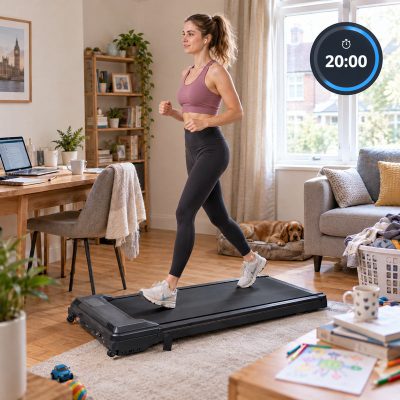
We all know that regular exercise is good for us. It helps keep our bodies healthy, improves our mood and can leave us feeling more energetic throughout the day. The difficult part isn’t always knowing that we should exercise. It’s finding the time to do it.
For people who work from home or follow a hybrid working pattern, the day can easily become a collection of interrupted tasks. One minute you’re answering emails, the next you’re joining a meeting, helping the children with their homework or dealing with something that can’t wait. Before you know it, the working day is over, and exercise has once again been pushed aside.
So, is 20 minutes on a treadmill really worth it?
Yes, absolutely. You don’t need an hour at the gym or an ambitious running programme to make a positive change. Even a short daily session can help you become more active, particularly if you spend most of your working day sitting down.
I know this from personal experience. My job involves long hours at a desk, and over time, I started experiencing considerable discomfort around my neck and lower back. Since making time for 15 to 30 minutes on a treadmill each day, I’ve noticed that the pain has eased considerably.
It hasn’t happened overnight, and I wouldn’t claim that a treadmill can solve every problem associated with back or neck pain. But the difference I’ve noticed has been encouraging, and it’s reminded me that small changes can be more valuable than we sometimes realise.
When Running in the Park Became Another Source of Stress
About two months ago, I decided it was time to get back into exercise. I started going to the local park for a run every day, and for the first couple of weeks, things went reasonably well.
Getting outside felt refreshing, and I liked the idea of doing something positive for my health. I thought I’d finally found a routine that worked.
Then everyday life started getting in the way.
Some days, the weather was awful. On others, my children’s homework needed attention, or an urgent task at work meant I couldn’t leave when I’d planned to. None of these situations was unusual, but each one made running a little harder to fit into my day.
The problem was that going for a run involved more than the time I spent exercising. I had to find a suitable window, get changed, travel to the park and allow time to get home again. When my schedule was already full, even a short run began to feel like a commitment I couldn’t always keep.
Gradually, something that was supposed to make me feel better started to feel like another item on my to-do list.
Eventually, I stopped running and slipped back into my old routine. I was sitting at my desk for most of the day again, with little regular exercise to break it up.
Looking back, I realised that the problem wasn’t running itself. I had chosen a way of exercising that didn’t fit particularly well around my everyday responsibilities.
That was when I started looking for a simpler alternative. Rather than trying to find time to go out, I wanted something I could do at home whenever a spare 20 minutes became available.
Using a treadmill turned out to be a much more practical option.
Why 20 Minutes on a Treadmill Can Be Worth It
The real value of a short treadmill workout isn’t that it produces dramatic results in a few minutes. It makes regular physical activity more achievable.
Here are the main reasons those 20 minutes can be worthwhile.
It Helps You Move More After Hours at a Desk
Sitting for long periods can leave your neck, shoulders, hips and back feeling stiff, particularly if you spend hours concentrating on a computer screen.
Walking on a treadmill gives you an opportunity to change position, move your legs and engage your muscles instead of remaining in the same posture throughout the day.
In my case, making time for regular movement has coincided with a noticeable reduction in neck and back discomfort. While a treadmill isn’t a treatment for every cause of pain, it has encouraged me to break away from my desk and become more active.
It Contributes to Your Weekly Exercise Target
Twenty minutes might not sound like much, but it adds up. A daily session amounts to 140 minutes of exercise a week, bringing you close to the NHS recommendation of at least 150 minutes of moderate-intensity activity for adults.
Brisk walking alone can contribute towards that target. You don’t have to run fast, cover a particular distance or finish every workout exhausted for it to count.
It Can Improve Your Energy and General Fitness
Regular walking and jogging can help improve cardiovascular fitness and stamina. As your body becomes more accustomed to physical activity, everyday tasks may begin to feel less tiring.
Exercise can also provide a useful mental break from work. Stepping away from emails and deadlines, even briefly, gives you a chance to reset before returning to whatever needs your attention.
It Removes Some of the Obstacles That Make Exercise Difficult
When your treadmill is at home, you don’t need to plan a journey to the park, wait for suitable weather or find a large block of uninterrupted time.
You can use it before work, during a break or in the evening. That flexibility is especially useful when working hours and family responsibilities change from one day to the next.
For busy people, convenience isn’t a minor benefit. It can be the difference between exercising regularly and giving up because finding the time feels too difficult.
What Can You Do on a Treadmill in 20 Minutes?
One of the best things about a treadmill is that you don’t have to use it for running alone. The right workout depends on your current fitness level and what you want to achieve.
Brisk walking is a good starting point if you’re new to exercise or simply want to move more during the day. Choose a comfortable pace that makes you breathe a little faster while still allowing you to hold a conversation.
Incline walking adds a little more challenge if your treadmill has an incline function. Walking uphill requires more effort from your leg muscles and can increase the intensity of your workout without requiring you to run.
Walking and jogging intervals are worth trying if you’re looking to improve your stamina. You could alternate short periods of easy jogging with longer periods of walking, adjusting the pace to suit your ability.
Gentle walking is also useful on days when you’re tired or have spent hours concentrating on work. You don’t need to push yourself hard every time. Sometimes, simply getting out of your chair and moving for 20 minutes is enough to make the effort worthwhile.
Whatever you choose, start at a level that feels manageable and increase the intensity gradually. If you’re new to exercise, there’s no need to rush into running. Consistency and safety matter more than speed.
A Small Change Can Make a Real Difference
My experience has taught me that the best exercise routine isn’t necessarily the most ambitious one. It’s the one that fits into your life well enough for you to keep doing it.
I spent two weeks trying to make daily outdoor running work, only to find that the demands of work and family life eventually got in the way. Having a treadmill at home has made it much easier to fit exercise into my day, and I’ve already noticed a welcome improvement in how I feel.
Your circumstances may be different, but the principle remains the same. You don’t have to find an hour, follow a complicated programme or make exercise the centre of your life to benefit from moving more.
Don’t dismiss 20 minutes simply because it seems insignificant. Many meaningful changes begin with small steps, and those steps can add up over time.
If you want a more comfortable, practical home for everyday living, Home Pet Essentials offers a range of home and lifestyle products, including selected fitness and exercise equipment.