

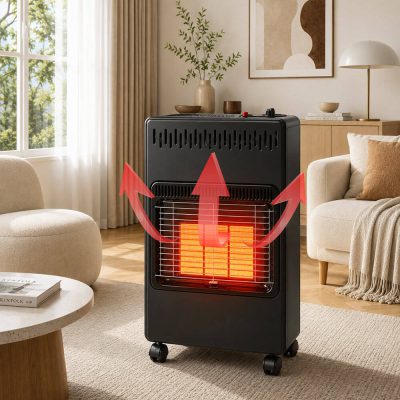
When the temperature drops in the UK, keeping the house warm without letting the energy bills spiral out of control becomes a familiar winter challenge. Nobody wants to spend a fortune heating an empty room, yet sitting in a cold living room with a blanket over your knees is hardly an ideal solution either.
Portable gas heaters and electric heaters are two options many households consider. Both can provide extra warmth without requiring a new central heating system, but their running costs are not as straightforward as they might first appear.
Gas is often assumed to be cheaper because the unit price of gas is much lower than electricity. That is true for mains gas, but a portable gas heater typically uses bottled LPG, which costs considerably more per unit of energy. Efficiency, heat output, how long you run the heater and which part of the house you want to warm all affect the final bill.
So, are portable gas heaters actually cheaper to run than electric heaters in the UK? Let’s work through the numbers.
How Much Does It Cost to Run an Electric Heater in the UK?
The simplest way to estimate the running cost of an electric heater is to multiply its power consumption by your electricity unit rate.
For this comparison, we will use the Ofgem price cap rates for 1 October to 31 December 2026. The average electricity unit rate for households on a standard variable tariff paying by Direct Debit in England, Scotland and Wales is 26.32p per kWh. Your own rate may differ depending on your tariff and region.
A 2,500W electric heater is equivalent to 2.5kW. If it runs continuously at full power for one hour, it consumes 2.5kWh of electricity.
The calculation is straightforward:
2.5 kW × 26.32 p = 65.8 p per hour.
That gives us the following estimates for a heater operating continuously at full power.
| Running time | Electricity cost |
| 1 hour | £0.66 |
| 2 hours | £1.32 |
| 4 hours | £2.63 |
| 6 hours | £3.95 |
| 8 hours | £5.26 |
These figures are estimates, rounded to the nearest penny. They assume the heater stays on at full power throughout the period, without a thermostat switching it off or reducing its output.
In practice, a thermostatically controlled heater may consume less electricity once the room reaches the target temperature. If you use a 2,500W heater for four hours but it only operates at full power for half that time, for example, its electricity consumption would be around 5kWh rather than 10kWh.
The distinction matters. The wattage printed on the heater tells you its maximum power consumption, not necessarily how much electricity it will use during every hour of normal operation.
What Does a Portable Gas Heater Cost to Run?
Portable gas heaters commonly use bottled LPG, such as butane or propane. Unlike a mains gas boiler, they do not draw fuel from your household gas supply, so the mains gas price shown on your energy bill is not the right figure to use.
The cost depends on the price you pay for the gas cylinder, the amount of usable fuel it contains and the efficiency of the heater.
To make a fair comparison, we need to calculate how much fuel a gas heater requires to deliver the same amount of heat as the electric heater.
The Centre for Sustainable Energy uses an average efficiency of 92% for its example of a bottled-gas heater. Its published comparison uses an LPG energy price of 12.65p per kWh, based on March 2025 reference calculations. This is a useful illustration, but it is not a guaranteed current retail price for every UK gas cylinder.
Using those assumptions, a gas heater delivering 2.5kW of useful heat would need:
2.5kW ÷ 0.92 = 2.72kW of fuel input.
At 12.65p per kWh, the estimated running cost is:
2.72kWh × 12.65p = approximately 34.4p per hour.
That is around 34p an hour, compared with 66p for the 2,500W electric heater at the electricity rate used above.
On these assumptions, the bottled-gas heater costs about 48% less per hour to deliver the same nominal heat output.
However, there is an important qualification. The two energy prices come from different reference periods, and your actual LPG cost may be higher or lower. The comparison demonstrates how to calculate the costs; it does not mean every portable gas heater will always be cheaper.
What if the LPG cylinder costs more?
The best way to estimate your own running cost is to work backwards from the price of your cylinder.
Check the cylinder’s net fuel weight and the supplier’s stated energy content, or use the supplier’s cost-per-kWh information if available. Then divide the total refill or replacement cost by the usable energy in the cylinder.
For example, if your LPG works out at 18p per kWh rather than 12.65p, the same 2.5kW-output heater operating at 92% efficiency would cost:
2.72kWh × 18p = approximately 49p per hour.
That is still below the estimated 66p electric-heater cost in this example, but the saving is smaller.
Cylinder rental, delivery charges, deposits and any minimum purchase costs can also affect the overall economics. If you already own a suitable cylinder and can buy refills locally, your costs may differ from those of someone starting from scratch.
Comparing Both Heaters at 2,500W
Comparing heaters with the same useful heat output is more meaningful than simply comparing their wattage labels.
An electric heater rated at 2,500W typically converts almost all the electricity it consumes into heat within the room. A gas heater needs to burn more than 2.5kW of fuel to deliver 2.5kW of useful heat because some energy is lost in the conversion process.
Using the assumptions above, here is the comparison.
| Comparison | Electric heater | Portable LPG heater |
| Useful heat output | 2.5kW | 2.5kW |
| Assumed efficiency | Near 100% at point of use | 92% |
| Energy input per hour | 2.5kWh | 2.72kWh |
| Energy price used | 26.32p/kWh | 12.65p/kWh |
| Estimated hourly cost | 65.8p | 34.4p |
The important point is that the gas heater uses more energy than the electric heater to produce the same amount of useful heat, but the assumed price per unit of LPG is lower. That lower fuel price more than offsets the efficiency difference in this example.
For an individual household, though, the result could be different. If bottled LPG is expensive in your area, or you use an electric heater with a thermostat that cycles off regularly, the gap may narrow.
How Much Could You Save Over a Winter?
An hourly difference can look modest, but the total becomes more significant if you use a heater for several hours a day.
Using the estimated costs of 65.8p per hour for electricity and 34.4p per hour for LPG, the following examples show how the costs could add up.
| Usage pattern | Electric heater | LPG heater |
| 2 hours a day for 30 days | £39.48 | £20.64 |
| 4 hours a day for 30 days | £78.96 | £41.28 |
| 6 hours a day for 30 days | £118.44 | £61.92 |
These figures assume continuous operation at the stated output, so they are not predictions of what every household will pay.
Suppose you work from home and spend most of the day in one room. Running a heater for four hours each evening might cost roughly £79 over 30 days using electricity, or £41 using LPG under our example assumptions. The difference is around £38 over that month.
Over a full winter, that could become a meaningful saving. But it is only a saving if the gas heater is genuinely replacing other heating use and the LPG is available at the assumed price.
There is also the cost of purchasing the heater, buying the cylinder and managing the fuel supply to consider. If you only need occasional extra warmth for a few cold evenings, the upfront cost may matter more than the hourly difference.
Localised Heating or Whole-House Heating?
One of the biggest factors affecting your winter energy bill is how much of your home you heat, and for how long.
If you spend most of the evening in the living room, using a portable heater to warm that space may be more economical than running central heating throughout the house. The same applies to a home office that is occupied for only part of the day.
However, the saving comes mainly from heating a smaller area rather than automatically choosing gas over electricity. A portable LPG heater may cost less per hour than an electric heater under certain fuel-price conditions, but the difference depends on the price of your bottled gas and the amount of heat you actually need.
For a larger home where several rooms need to stay warm, central heating may be more practical than running multiple portable heaters. Insulation, draughts and the length of time each room is occupied will all influence the final cost.
The most economical approach is usually to match the heating method to how you use your home, rather than relying on the fuel type alone. If you use a portable gas heater indoors, make sure the model is suitable for indoor use and follow the manufacturer’s ventilation instructions.
Which Is the Better Choice for Your Home?
For households trying to manage winter energy bills, the right choice depends on more than the fuel price.
A portable LPG heater may have a lower running cost than a 2,500W electric heater when the LPG is bought at a favourable price, and both appliances deliver the same useful heat output. In our example, the difference is around 31p per hour.
An electric heater may be the more convenient option for short periods of supplementary heating. There is no gas cylinder to buy or replace, and many models offer straightforward thermostatic control. If you only need to warm a small area for an hour or two, simplicity may be worth more than a modest difference in running costs.
For regular use, calculate your actual fuel price, check the heater’s useful heat output and consider how much space you need to warm. Also account for purchase costs, ventilation requirements and the practicalities of storing and replacing LPG cylinders.
Home Pet Essentials offers a range of home and seasonal essentials for UK households. If you are preparing your home for colder weather, you can explore its relevant home products alongside your wider plans for keeping your living space comfortable and managing winter costs.