

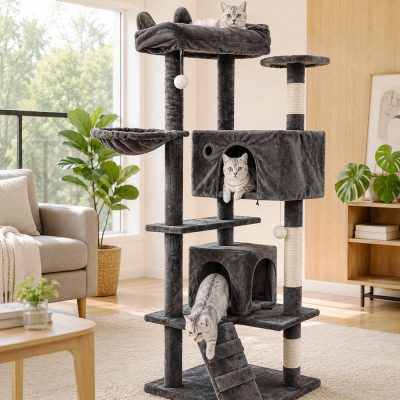
There is a particular kind of frustration that almost every cat owner knows.
You watch your cat for a while and start noticing a pattern. It spends an unreasonable amount of time sitting on top of the wardrobe. Then, when you move something on the bookcase, it immediately claims the highest shelf. If the fridge happens to offer a good view of the kitchen, that becomes another favourite spot.
After watching this behaviour for long enough, the conclusion seems obvious: your cat likes being up high.
So you buy a cat tree.
It arrives, you put it together, find a sensible place for it, and perhaps even add a little toy to make it more appealing. You step back and wait for your cat to investigate its new climbing tower.
Nothing.
Your cat walks past it as though you have just assembled a rather strange piece of furniture for yourself.
A few days later, the cat is back on top of the wardrobe.
It is difficult not to feel slightly offended.
But there is actually a good reason why this happens. Cats do not necessarily want height for its own sake. They care about what that height gives them: a safe place to rest, a useful view of their surroundings, a comfortable escape from activity and a position that feels familiar.
That distinction matters.
A cat tree can provide plenty of height and still fail the test from your cat’s point of view.
Why Vertical Space Matters in a British Home
Britain is very much a nation of cat lovers. The latest Cats Protection Cats Report estimates that almost one in four UK households owns a cat, while PDSA estimates the UK has around 10.5 million pet cats.
The challenge is that our homes are not always particularly generous when it comes to floor space.
A cat living in a smaller flat or a typical terraced house cannot suddenly acquire another room because it needs somewhere to climb, explore or retreat. The available floor area remains the same, which makes vertical space much more interesting.
A well-designed cat tree can effectively give a cat another layer of usable territory without taking over the entire room.
This is particularly useful for indoor cats. PDSA’s 2024 figures estimated that 31% of UK cats live indoors only.
For those cats, the home is not just where they sleep at night. It is where they spend their time, explore their surroundings, watch what is happening and find places where they feel comfortable.
So a cat tree can be a genuinely useful addition to a home.
The problem is that simply buying one does not guarantee that your cat will use it.
Your Cat Likes High Places, But That Is Not the Whole Story
This is where my imaginary experiment with the wardrobe starts to fall apart.
If a cat repeatedly chooses the top of a wardrobe, it is tempting to think that height itself must be the attraction. But look more closely at what the wardrobe actually offers.
It may be stable enough that the cat never feels movement underneath its paws. From the top, the cat can see most of the room without anyone easily disturbing it. The surface probably smells familiar because it has been part of the home for years, and the location may give the cat a clear view of doors, windows and the people moving around below.
In other words, the wardrobe is not simply high.
It is familiar, stable, predictable and useful.
A cat tree that only offers height may therefore lose the comparison before your cat has even climbed it.
Is the Cat Tree Too Wobbly?
One of the first things worth checking is stability.
Cats are remarkably good at noticing movement. If a platform shifts noticeably when they step onto it, some cats will simply decide that the structure is not worth the risk.
This becomes particularly important with taller cat trees. The higher the structure, the more obvious any movement can become, especially if the base is relatively small or the tower sits unevenly on the floor.
Think about the difference between jumping onto a solid bookcase and climbing onto a tall structure that rocks slightly under your weight.
You might tolerate it because you know the cat tree is technically safe. Your cat does not have that reassurance.
If the first few attempts feel unstable, it may decide that the wardrobe offers a much better experience.
That does not necessarily mean the cat tree itself is badly made. It may simply need a firmer position, a more level floor or a different location where the structure receives less accidental movement.
Have You Put It in the Wrong Place?
This is probably one of the most common reasons a perfectly good cat tree gets ignored.
We often choose furniture based on what makes sense to us.
A cat tree might end up in an empty corner because that keeps the room tidy. From a human perspective, it seems ideal. It is out of the way and does not interfere with everyday life.
Your cat may have a completely different opinion.
Imagine putting a comfortable armchair in a room where nobody ever goes and then wondering why you prefer the sofa in the living room.
Cats also pay attention to what happens around them. A cat may want a quiet place to sleep at certain times, but it may also enjoy watching people, listening to familiar household activity or looking outside.
A cat tree positioned near a window can offer a completely different experience from one hidden behind a sofa.
The same applies to the height of the room around it. If your cat already spends hours watching the world from a particular window or shelf, placing the new cat tree somewhere that offers no comparable view may make it far less interesting.
A Good View Can Be More Important Than Another Platform
When choosing a cat tree, it is easy to focus on the number of levels.
More platforms sound better.
But from the cat’s perspective, the location of those platforms may matter much more.
A high platform that gives your cat a clear view of the room can be far more attractive than another level facing a wall. If the cat can watch people moving through the room, see what is happening near a doorway or look out of a window, the tower becomes part of its environment rather than simply another object to climb.
This also explains why a cat may prefer the top of a bookcase.
It has probably chosen that particular spot because it gives the cat something useful to look at.
So before moving the cat tree into the least noticeable corner of the room, look at the room from your cat’s perspective. What can it see from the top? Can it watch the room without sitting directly in the middle of the activity? Does it have access to a window or another interesting view?
Sometimes moving the cat tree by only a small distance can make a surprisingly large difference.
The Platforms May Not Feel Comfortable
A cat tree can look impressive in a product photograph while feeling rather different to a real cat.
Platform size is particularly important.
If a cat can only squeeze onto the top platform with its paws hanging over the edge, it may not see much reason to use it for resting. A cat that likes to curl up, stretch out or change position during sleep needs enough space to do so comfortably.
This becomes even more relevant with larger cats.
A small platform may work perfectly well for a kitten, yet become much less useful as the cat grows. If the cat cannot settle comfortably, it may return to the wardrobe or another piece of furniture that gives it more room.
When assessing a cat tree, it is therefore worth thinking beyond the overall height. Consider whether the resting areas actually suit the size and habits of your cat.
Is the Cat Tree Too Close to Noise and Activity?
Cats can enjoy being around their owners without wanting to sit directly in the middle of everything.
That distinction is easy to miss.
A cat tree placed beside a television, a busy doorway, or an area where people constantly walk past may offer plenty of activity, but not necessarily the kind of environment your cat wants when it is trying to relax.
A particularly nervous or easily startled cat may prefer somewhere that allows it to observe the household without becoming part of the traffic.
This is why there is no universally perfect position for a cat tree.
One cat may love sitting beside the living room window while another may prefer a quieter corner where it can watch the room from a distance. The important thing is to pay attention to what your own cat already chooses.
If your cat consistently avoids busy areas when it sleeps, putting the cat tree in the busiest part of the house probably will not change its personality.
Familiarity Matters More Than You Might Expect
There is another reason a new cat tree can sit untouched for days.
It smells new.
The room has not changed from your perspective, but the cat notices new objects differently. A newly assembled tower may have unfamiliar smells from the materials, packaging and manufacturing process. It also looks completely different from the furniture your cat has known for months or years.
Some cats will investigate immediately.
Others take their time.
If your cat ignores the new tower for the first few days, that does not necessarily mean you have bought the wrong product. Give it some time and avoid constantly moving it around or placing the cat on it yourself.
Let the cat investigate at its own pace.
You can make the tower more familiar by placing it somewhere your cat already likes to spend time. A familiar blanket or bedding can also help make the new space feel less strange.
The important thing is not to turn the introduction into a battle of wills.
Cats are generally very good at making their opinions clear.
What About the Cat That Uses Everything Except the Cat Tree?
This is where observing your cat becomes much more useful than simply reading a buying guide.
Look at where your cat already spends time.
Does it prefer the top of a wardrobe because it wants height? Does it always choose a particular window because it likes watching outside? Does it avoid areas where people walk past? Does it choose furniture with a particular texture? Does it sleep somewhere because the surface feels warm?
These details tell you what your cat actually values.
A cat tree should fit those preferences rather than forcing the cat to develop completely new ones.
If your cat loves watching birds through the window, position the tree so that it provides a similar view. If it likes staying near the family but away from foot traffic, a position overlooking the living room may work better than an isolated corner. If stability seems to matter, make sure the structure feels solid before expecting the cat to trust it.
The more closely the cat tree matches an existing preference, the easier the transition tends to be.
Give Your Cat a Reason to Explore It
Sometimes the structure itself is fine, but the cat simply has not discovered what makes it useful.
A little encouragement can help.
You might place a favourite toy on one of the lower platforms or use a small amount of play to encourage the cat to investigate. If your cat already enjoys resting on a particular blanket, moving that familiar item onto the tree can make the new furniture feel less unfamiliar.
What you do not need to do is repeatedly pick the cat up and place it on the highest platform.
That may work for a photograph, but it does not necessarily convince the cat that the tree belongs to it.
The aim is to let the cat discover the benefits for itself.
Once it realises that the tower provides a comfortable place to rest, a good view or a quiet escape, you may find that it starts using the tree without any further encouragement.
A Cat Tree Is About More Than Height
The more you watch cats, the more obvious this becomes.
They do not climb simply because something happens to be tall.
Height can give them a better view, a sense of security and a way to observe their surroundings without sitting directly in the middle of household activity. A good cat tree brings those benefits together, but its position and design still need to suit the individual cat.
That is why two cats can react completely differently to the same product.
One may move in immediately and claim the highest platform. Another may sniff it once, walk away and continue sleeping on the wardrobe.
Neither cat is necessarily behaving strangely.
They are simply making different choices based on what feels comfortable and useful to them.
The Simple Cat Tree Test
If your cat ignores its new cat tree, do not immediately assume that you bought the wrong one.
Start by looking at the structure itself. Does it feel stable when your cat climbs onto it? Are the platforms large enough for comfortable resting? Can the cat reach the higher levels without feeling awkward or exposed?
Then look at the location.
Does the tree provide a useful view? Is it close to a window or somewhere your cat already likes? Does the surrounding area feel calm enough for resting, or does everyone in the house walk past it every few minutes?
Finally, give the cat some time.
A new piece of furniture does not instantly become part of a cat’s territory. Familiar smells, a suitable position and repeated positive experiences can all help the cat decide that the tree is worth using.
Most importantly, watch what your cat already does before deciding where the tree should go.
Your cat has probably been telling you what it likes all along.
You just need to pay attention.
Buying a Cat Tree Is Only Half the Job
A cat tree can be a very useful addition to a British home, particularly when floor space is limited, and your cat spends much of its time indoors. But buying the tallest or most elaborate model you can find does not automatically make it attractive to your cat.
The real trick lies in matching the tree to the animal that will actually use it.
A stable structure, comfortable platforms, a useful view and a sensible location can make far more difference than simply adding another level. Once you start looking at the room from your cat’s point of view, the reason behind its favourite spots often becomes surprisingly obvious.
Buying a cat tree is only half the job. Choosing and placing it properly is the other half.
And if your cat still chooses the top of the wardrobe afterwards, well, at least you can say you tried.