

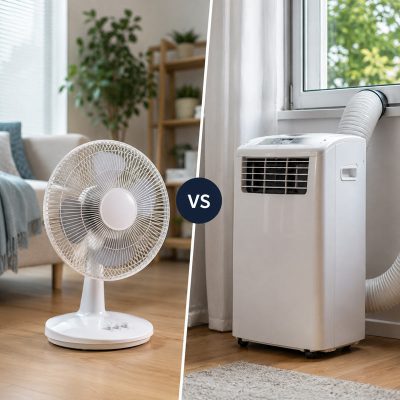
A few days ago, parts of the UK suddenly jumped to 31°C, and like clockwork, the internet went into full survival mode.
Searches for “best cooling fan UK”, “portable air conditioner”, and “how to cool a bedroom in summer” started climbing almost immediately. Retailers saw popular cooling products disappear from stock overnight. Social media is filled with videos of people trying everything from blackout curtains to frozen hot water bottles.
This happens almost every summer now.
The UK still isn’t built for prolonged heat. Many homes trap warmth surprisingly well, loft conversions become ovens by late afternoon, and south-facing flats can feel unbearable after a few days of sunshine.
So the same question keeps coming back every year:
Should you buy an electric fan or invest in air conditioning?
And more importantly for many UK households right now:
Which one is actually cheaper in the long run?
The answer is not as simple as people think. Electricity costs are only one part of the story. Installation, planning restrictions, maintenance, energy efficiency, noise levels, and even the type of property you live in all matter more than most buyers realise.
Let’s break it down properly, using realistic UK costs and real-world usage rather than marketing hype.
Why So Many UK Homes Struggle During Hot Weather
Unlike southern Europe, most UK homes were designed to keep heat in, not push it out.
That becomes a problem during sudden summer heatwaves.
Common issues include:
- Small windows with limited airflow
- Loft bedrooms trapping hot air
- Brick walls store daytime heat
- Poor ventilation
- No built-in cooling systems
A lot of British homes also rely on carpets, thick curtains, and insulation designed for winter efficiency. Great in January. Less enjoyable when the bedroom still feels like a sauna at midnight.
That’s why cooling products now sell out faster every year.
And because air conditioning is still relatively uncommon in the UK compared to countries like Spain or the US, many people end up debating between:
- portable air conditioners
- tower fans
- pedestal fans
- desk fans
- evaporative coolers
Most households start with a fan because the upfront cost feels safer.
But does that actually save money over time?
What an Electric Fan Really Costs in the UK
Let’s start with fans.
For most UK households, electric fans are the easiest and cheapest cooling option.
Typical prices:
- Desk fan: £15–£30
- Tower fan: £40–£120
- Pedestal fan: £25–£80
- Premium bladeless fan: £150+
The big advantage is obvious:
You plug it in, and it works immediately.
No installation.
No pipework.
No planning concerns.
No landlord approval in most cases.
That simplicity is why fans dominate the UK market whenever temperatures spike.
The Electricity Cost of Running a Fan
Most modern electric fans are surprisingly cheap to run.
A standard tower fan usually uses:
- 40W to 60W
Let’s use 50W as a realistic average.
The current UK electricity price cap fluctuates, but many households are paying roughly:
- 22p to 30p per kWh
Using 27p per kWh as a rough middle point:
0.05\text{ kW} \times 8\text{ hours} \times £0.27 \approx £0.11
That means running a typical fan for 8 hours costs around 11p per day.
Over a month of daily summer use:
£0.11 \times 30 \approx £3.30
That is incredibly affordable.
Even larger tower fans often cost less than a takeaway coffee per month to run.
This is one reason many UK households stick with fans even during hotter summers.
But Fans Have Limitations
Fans do not actually lower the room temperature.
This is the biggest misunderstanding.
They move air around to help sweat evaporate faster, which makes your body feel cooler.
That works well:
- during moderate heat
- in ventilated rooms
- overnight
- in smaller spaces
But once indoor temperatures climb into the high twenties, fans can start feeling less effective.
Especially in:
- top-floor flats
- conservatories
- loft bedrooms
- poorly ventilated rooms
Sometimes all you get is hot air blowing directly at your face.
That is usually the moment people start searching for portable air conditioning.
The Real Cost of Air Conditioning in the UK
This is where things become more complicated.
Air conditioning can absolutely cool a room properly.
But the overall costs are much higher than many people expect.
There are several categories to think about:
- purchase cost
- installation
- electricity usage
- maintenance
- permissions
- long-term efficiency
Portable Air Conditioners
Most UK households begin with portable AC units because they avoid permanent installation.
Typical cost:
- £250–£700
These units usually vent hot air through a window kit.
They are convenient but come with trade-offs:
- noisy operation
- bulky size
- lower efficiency
- window sealing issues
Still, during a heatwave, they can feel life-changing.
Especially for bedrooms.
Split-System Air Conditioning
This is the “proper” air conditioning setup seen in offices and newer homes.
It includes:
- an indoor unit
- an outdoor condenser
- professional installation
Typical UK costs:
- £1,500–£3,500 for one room
- higher for multiple rooms
Installation costs vary massively depending on:
- wall access
- electrical work
- pipe routing
- property type
In flats or listed buildings, permissions can become more complicated.
Do You Need Permission for Air Conditioning in the UK?
Sometimes, yes.
This catches many homeowners off guard.
Portable AC units usually do not require permission.
But fixed split systems may involve:
- landlord approval
- leaseholder restrictions
- planning considerations
- conservation area rules
Especially in:
- listed buildings
- flats
- heritage properties
Some developments also restrict visible outdoor condenser units because of appearance or noise concerns.
This means the “real” cost of air conditioning can include:
- application fees
- installation surveys
- specialist contractors
People rarely think about this during a heatwave panic-buy.
How Much Electricity Does Air Conditioning Use?
This is where running costs start to separate dramatically from fans.
A portable air conditioner often uses:
- 900W to 1500W
Let’s use 1200W as a realistic example.
Running it for 8 hours daily:
1.2\text{ kW} \times 8\text{ hours} \times £0.27 \approx £2.59
That is roughly £2.59 per day.
Over a month:
£2.59 \times 30 \approx £77.70
That is a huge jump compared to fan usage.
And many households run AC longer than 8 hours during heatwaves.
Now compare that to the earlier fan example:
- Fan monthly cost: around £3
- Portable AC monthly cost: around £78
That difference becomes very noticeable on UK energy bills.
Why Portable AC Units Often Disappoint
A lot of first-time buyers expect portable AC to behave like built-in air conditioning.
But portable units struggle in some UK homes because:
- Window venting is inefficient
- Warm air leaks back in
- rooms are poorly insulated against heat
- Units are undersized
Many also produce a surprising amount of noise.
Trying to sleep beside one can feel like sharing a room with a small vacuum cleaner.
This is why some people eventually move toward fixed split systems despite the higher upfront cost.
Are Fixed Air Conditioning Systems Cheaper Long-Term?
Sometimes.
Split systems are generally:
- quieter
- more efficient
- better at cooling larger spaces
Modern inverter systems can use significantly less electricity than portable AC units.
But the upfront investment remains high.
If you only experience a few weeks of extreme heat each year, recovering those costs takes time.
For many UK households, a quality fan plus smarter heat management may still make more financial sense.
The Hidden Costs People Forget
This is where buying decisions often go wrong.
People focus only on:
“How much is the appliance?”
But forget everything around it.
Fans
Hidden costs are minimal:
- occasional cleaning
- replacement after several years
- almost no maintenance
Air Conditioning
Additional costs can include:
- annual servicing
- refrigerant issues
- installation repairs
- replacement hoses
- drainage management
- Higher insurance considerations
In rented properties, there is also the risk that:
- Installation is not allowed
- modifications are restricted
- Window venting becomes impractical
Which Option Feels Better During a Heatwave?
This depends on the type of heat.
For:
- 24°C to 27°C
- cooler evenings
- decent airflow
A fan is often enough.
Especially if combined with:
- blackout curtains
- closed daytime blinds
- open windows at night
- lighter bedding
But once indoor temperatures stay above 28°C overnight, fans become less effective.
That is when proper air conditioning starts feeling worth every penny.
Sleep quality alone becomes a major factor.
Anyone who has tried sleeping in a 30°C loft bedroom during a humid UK heatwave knows exactly what that feels like.
The Smartest Setup for Most UK Homes
Interestingly, many experienced homeowners do not fully commit to either extreme.
They combine strategies.
For example:
- tower fan for daily use
- portable AC only during peak heatwaves
- blackout curtains
- ventilation timing
- cooler bedding
- dehumidifiers
This usually creates the best balance between comfort and energy costs.
Running air conditioning non-stop throughout summer in the UK often makes little financial sense unless:
- You work from home full-time
- Your property traps heat badly
- health conditions require cooler temperatures
So Which One Is Actually Cheaper?
If we are talking purely about cost:
Electric fans win easily.
Lower purchase price.
Almost no installation.
Tiny electricity usage.
Minimal maintenance.
But if we are talking about cooling performance during extreme heat:
Air conditioning wins comfortably.
The real decision comes down to:
- Your property type
- heat tolerance
- budget
- room size
- long-term usage habits
For many UK households, especially during short heatwaves, a good electric fan still offers the best overall value.
That is why demand for tower fans, quiet bedroom fans, and high-airflow cooling fans continues to surge every summer whenever temperatures suddenly spike again.
Retailers like Home Pet Essentials now offer a wide range of electric fans designed for UK homes, including compact desk fans, oscillating tower fans, and quiet cooling solutions for bedrooms and home offices.
And honestly, for a lot of people dealing with another unpredictable British summer, that simple setup may still be the most sensible choice.