

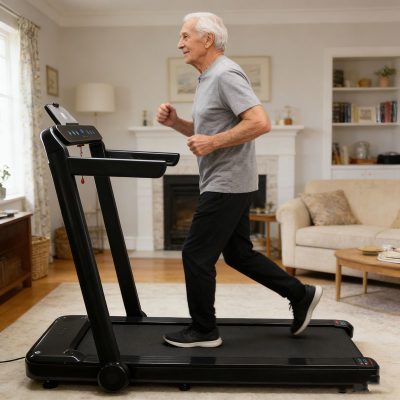
As people live longer and place greater value on healthy ageing, staying active in later life has become a priority for many families across the UK. One question that often comes up is: Can older adults safely use a treadmill? The short answer is yes — but with the right conditions, precautions, and expectations.
A treadmill can be an excellent way for seniors to stay active, especially in the UK, where unpredictable weather and limited daylight in winter can make outdoor walking less appealing. However, not every older person is suited to treadmill exercise, and how it’s used matters just as much as whether it’s used at all.
This article explores which older adults can benefit from using a treadmill, who should avoid it, how long seniors should exercise each day, what warm-up and cool-down routines are essential, and the key health benefits treadmill walking can offer. All advice is grounded in real-life UK home environments and climate conditions.
Is a Treadmill Suitable for Older Adults?
The General Answer
For many seniors, a treadmill is a safe, controlled, and convenient way to stay active. Walking remains one of the most recommended forms of exercise for older adults, and a treadmill simply brings that walk indoors — with more consistency and fewer external risks.
That said, suitability depends on:
- Overall mobility
- Balance and coordination
- Existing medical conditions
- Confidence with equipment
A treadmill is not about speed or intensity for older users. It’s about maintaining movement, independence, and confidence.
Which Older Adults Can Safely Use a Treadmill?
Suitable Groups
A treadmill may be appropriate for older adults who:
- Can walk independently
- Have mild joint stiffness or early-stage arthritis
- Are you managing controlled conditions such as high blood pressure or type 2 diabetes
- Want to maintain cardiovascular health without high-impact exercise
- Prefer exercising indoors due to weather or safety concerns
For many UK seniors living in flats or terraced homes, a treadmill offers a predictable, private environment that feels safer than uneven pavements or busy streets.
Who Should Avoid Using a Treadmill?
Medical Conditions Requiring Caution or Avoidance
Not all seniors should use a treadmill without medical clearance. It may not be suitable for older adults who have:
- Severe balance disorders or frequent dizziness
- Advanced osteoporosis with a high risk of fracture
- Uncontrolled heart conditions
- Severe joint degeneration causing pain even during slow walking
- Neurological conditions that impair coordination
If there’s any doubt, a GP or physiotherapist should be consulted first — a common and accessible step within the UK healthcare system.
How Long Should Older Adults Use a Treadmill Each Day?
Recommended Duration
For most seniors, 20–30 minutes per day is a safe and effective starting point. This does not need to be continuous.
A sensible structure might be:
- 10 minutes in the morning
- 10–15 minutes later in the day
As fitness improves, some older adults may gradually increase to 40–45 minutes, provided the pace remains comfortable.
Frequency Matters More Than Intensity
Consistency is more important than speed or incline. Gentle daily walking offers more benefits than occasional longer sessions.
In colder UK months, a treadmill helps maintain regular movement when outdoor walks might otherwise be skipped.
The Importance of Warm-Up Before Treadmill Exercise
Why Warm-Up Is Essential for Seniors
Older muscles and joints need more time to prepare for movement. Skipping a warm-up increases the risk of:
- Muscle strain
- Joint pain
- Sudden stiffness or imbalance
Simple Warm-Up Routine (5–8 Minutes)
Before stepping onto the treadmill:
- Gentle ankle circles while seated
- Shoulder rolls to loosen upper body tension
- Slow marching on the spot
- Light stretching of calves and thighs
Once on the treadmill, begin with 2–3 minutes of very slow walking to allow the body to adjust.
Cooling Down and Stretching After Exercise
Why Cool-Down Matters
Stopping suddenly can cause dizziness or muscle tightness, especially in older adults. A proper cool-down helps:
- Stabilise heart rate
- Reduce stiffness
- Improve recovery
Simple Cool-Down Routine
After finishing treadmill walking:
- Walk slowly for 2–3 minutes
- Stretch calves, hamstrings, and lower back
- Gently stretch shoulders and arms
This routine is especially helpful during colder UK seasons, when muscles cool down faster.
Key Benefits of Treadmill Use for Older Adults
1. Improved Cardiovascular Health
Regular treadmill walking supports heart and lung function, helping seniors:
- Maintain healthy blood pressure
- Improve circulation
- Reduce fatigue during daily activities
2. Better Joint Mobility
Unlike running, treadmill walking is low-impact, making it suitable for ageing joints. Controlled movement helps reduce stiffness, particularly in the knees and hips.
3. Balance and Confidence
Using handrails and a stable walking surface can gradually rebuild confidence, especially for seniors who feel nervous outdoors.
4. Weight Management and Metabolism
While weight loss may not be the goal for all seniors, regular walking supports:
- Healthy metabolism
- Muscle maintenance
- Reduced risk of weight-related health issues
5. Mental Wellbeing
In the UK, shorter daylight hours and colder weather can affect mood. Indoor treadmill walking helps:
- Maintain routine
- Reduce feelings of isolation
- Support mental clarity and emotional well-being
Treadmill Use in UK Homes: Practical Considerations
Space and Noise
Many UK homes have limited space. Compact or foldable treadmills are often more suitable for:
- Flats
- Smaller living rooms
- Shared households
Quiet operation is also important, particularly in terraced housing or apartments.
Weather and Safety
Wet pavements, icy paths, and early sunsets make outdoor walking risky for seniors in the UK. A treadmill removes:
- Slip hazards
- Traffic concerns
- Weather-related interruptions
Professional Tips for Seniors Using a Treadmill
- Always start at the lowest speed
- Use handrails when needed — there’s no shame in safety
- Wear supportive footwear, even indoors
- Keep water nearby
- Stop immediately if dizziness, chest discomfort, or unusual pain occurs
A treadmill should support independence, not challenge it.
Frequently Asked Questions
Can a treadmill replace outdoor walking for seniors?
Yes, for many older adults, treadmill walking provides the same cardiovascular benefits as outdoor walking, with added safety and consistency.
Is walking on a treadmill safe for seniors with arthritis?
In many cases, yes. A treadmill’s cushioned surface can be gentler on joints than pavement, but speed and duration should be adjusted carefully.
Should seniors use incline settings?
Generally, incline is not necessary for older adults unless advised by a professional. Flat walking provides sufficient benefit for most seniors.
Final Thoughts
So, can older adults use a treadmill? For many, the answer is a confident yes — when used sensibly, safely, and with realistic expectations. A treadmill is not about pushing limits; it’s about preserving mobility, confidence, and quality of life.
In the context of UK living — where weather, space, and safety all play a role — a well-chosen treadmill can be a valuable addition to a senior-friendly home.
For households looking for practical, space-conscious fitness solutions designed for everyday use, Home Pet Essentials offers a range of thoughtfully designed products that support comfortable and convenient home exercise — helping older adults stay active, safely and at their own pace.